
Early Signs of Thalassemia Major in Children: What Every Parent Must Know
Thalassemia in children, particularly thalassemia major, is one of the most common inherited blood disorders in India, and one of the most underdiagnosed in its earliest stages. Dr. Satyendra Katewa – one of India’s leading pediatric hemato-oncologists with over 25 years of experience in managing complex blood disorders in children emphasises that recognising thalassemia symptoms in children early is not just important, but it can also be life-changing.
This blog aims to help parents understand what to look for, when to act, and what modern medicine offers their child.
What Is Thalassemia? Understanding the Basics
To understand what families are dealing with, one must first understand the thalassemia definition clearly. Thalassemia is an inherited blood condition in which the body fails to produce adequate amounts of haemoglobin, the protein within red blood cells responsible for carrying oxygen to every organ and tissue.
When haemoglobin production is impaired, red blood cells become short-lived, resulting in chronic anaemia.
The types of thalassemia are broadly divided into:
- Alpha thalassemia: Caused by mutations affecting alpha-globin chain production
- Beta thalassemia: Caused by mutations in the beta-globin gene, and the form most commonly seen across South Asia, the Mediterranean, and the Middle East.
Thalassemia Major vs Minor: Key Differences Explained
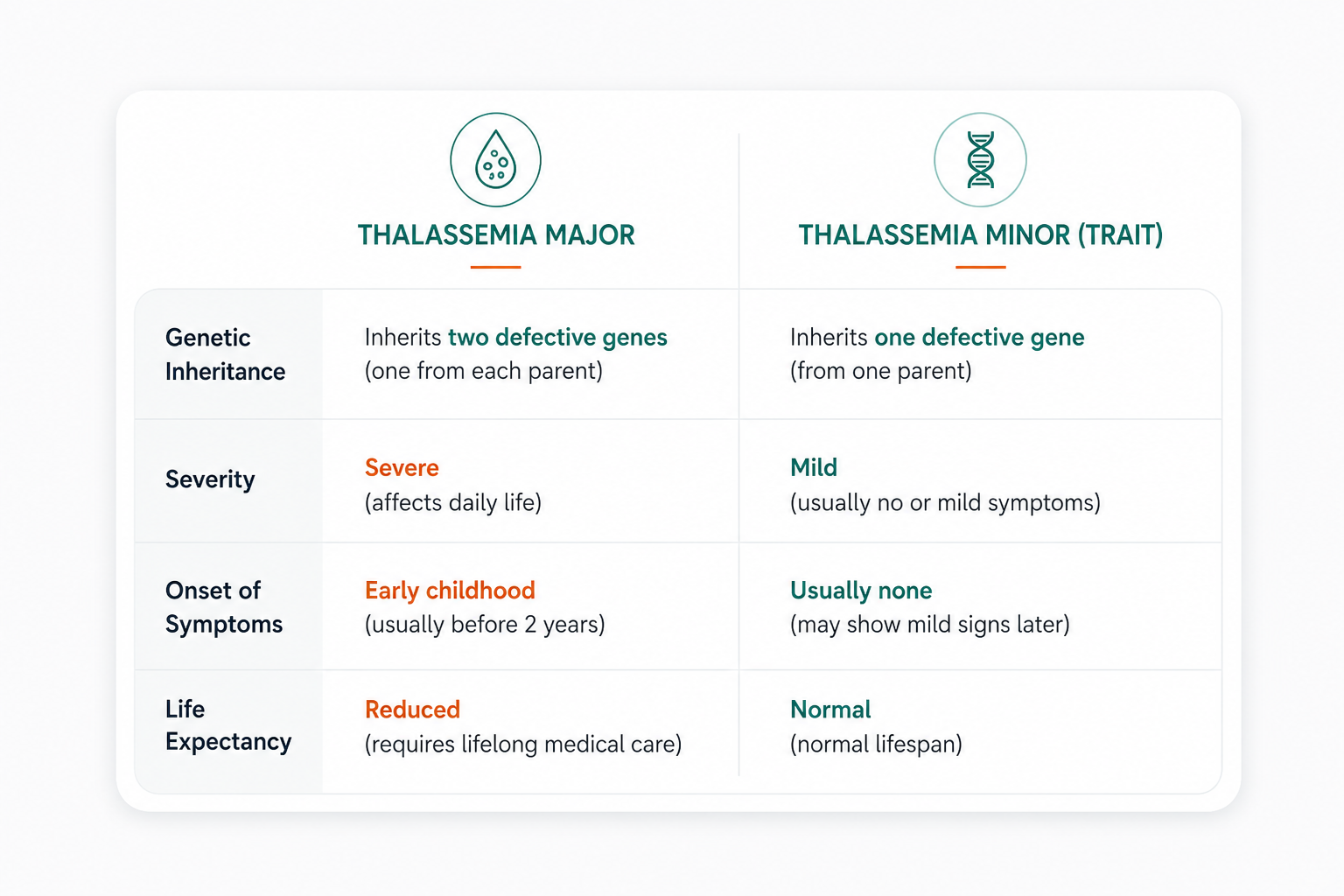
Thalassemia minor, also referred to as the thalassemia trait, occurs when a child inherits one defective gene from one parent. In practical terms, thalassemia minor means the child is a carrier of the condition.
Most children with thalassemia minor live entirely normal lives. Thalassemia minor symptoms, if present at all, are limited to mild anaemia that rarely requires treatment.
Thalassemia major occurs when a child inherits defective genes from both parents. This is the severe, transfusion-dependent form of thalassemia disease, and it is the form that demands urgent medical management beginning in the first year of life.
 Early Signs of Thalassemia Major in Children
Symptoms of thalassemia major typically begin to emerge between six months and two years of age, as fetal haemoglobin, which temporarily protects newborns, gives way to the defective adult haemoglobin.
Here is what to watch for:
1. Persistent, Unexplained Paleness
The most consistent symptom of thalassemia is a persistent paleness of the skin, lips, inner eyelids, and fingernails. Unlike the brief pallor associated with a common illness, this paleness does not resolve with rest or time.
2. Severe, Chronic Fatigue
Children with thalassemia major are usually tired, not because of a busy day, but because their bodies are not getting enough oxygen.
3. Swollen or Distended Abdomen
As the condition progresses untreated, the spleen and liver enlarge as the body’s effort to destroy defective red blood cells and compensate for chronic anaemia. Parents may notice that the child’s belly appears bloated or hard, even when the child has not eaten.
4. The Thalassemia Face
Among the more distinctive features of untreated thalassemia major is what is referred to medically as the chipmunk facies. When the body’s bone marrow is pushed to produce red blood cells at an accelerated rate, it expands outward into the bones of the skull and face. This leads to:
- A prominent, widened forehead (frontal bossing)
- High, prominent cheekbones
- Protrusion of the upper jaw and teeth
5. Jaundice
The rapid breakdown of defective red blood cells releases bilirubin (a yellow pigment) into the bloodstream. This causes jaundice: the yellowing of the skin and the whites of the eyes.
6. Slowed Growth and Delayed Puberty
Children with thalassemia major frequently fall behind their peers in height and weight. Growth monitoring is therefore a core component of any thalassemia treatment plan.
7. Prolonged illnesses
As chronic anaemia compromises immune function, children with thalassemia major tend to fall ill more often and take longer to recover. Infections that other children manage without difficulty may become serious in a child whose body is already under physiological stress.
Are the Parents Carriers? Understanding Thalassemia Trait Symptoms
A diagnosis of thalassemia major in a child almost always prompts testing of the parents and frequently reveals that both are thalassemia carriers who were previously unaware of their status.
Thalassemia carrier symptoms are subtle and easy to overlook because they are so mild that many carriers go undiagnosed for years, sometimes their entire lives.
Thalassemia Treatments: What Does Modern Medicine Offer?
Thalassemia treatments have advanced considerably, and children who receive consistent, well-managed care can live full and active lives.
Regular Blood Transfusions
Children with thalassemia major typically require blood transfusions every two to four weeks to maintain haemoglobin at a level that supports normal growth and activity.
Bone Marrow / Stem Cell Transplant
For eligible children with a well-matched donor, most often a healthy sibling, a stem cell transplant remains one of the established cures for thalassemia major.
Gene Therapy
Emerging gene therapy approaches for beta thalassemia are now offering new possibilities. These treatments aim to compensate for the defective gene directly, potentially freeing patients from lifelong transfusion dependence.
While not yet universally available, this field represents the most advancing field of care in thalassemia treatment today.
Supportive and Preventive Care
Folic acid supplementation, vaccinations, prophylactic antibiotics, regular cardiac and liver monitoring, and endocrine assessments are integral parts of the long-term care plan for children with thalassemia major.
When Should Parents Seek Evaluation?
Dr. Katewa advises parents to seek prompt evaluation if their child, particularly between the ages of six months and two years, shows any of the following:
- Persistent paleness that does not improve
- Unexplained fatigue or weakness
- A visibly swollen or hard abdomen
- Poor weight gain or feeding difficulties
- Yellowing of the skin or eyes
- A family history in which both parents are known thalassemia carriers
A blood count and haemoglobin electrophoresis can provide clarity quickly. The key is not to wait.
A Note to Every Family
A diagnosis of thalassemia major can deeply impact a family’s life, often bringing immediate concerns such as: Why has this happened? What does it mean for the child’s future? Can they lead a normal life? The clinical team at Dr. Satyendra Katewa’s practice has walked alongside many such families. The consistent message has always been that with early diagnosis, committed treatment, and regular follow-up, children with thalassemia major can grow, learn, play, and thrive. Science is advancing rapidly, and the hope for today’s children is better than ever.
The most important step any parent can take is the first one, recognising the signs, and seeking evaluation without delay.
Disclaimer: This article is intended for general informational purposes only and does not substitute professional medical advice, diagnosis, or treatment. Always consult a qualified healthcare provider for concerns related to your child’s health.

 WhatsApp