
If you or your child has been advised a bone marrow transplant, the first question is almost always the same: how much will it cost? Whether you’re searching for BMT cost in Delhi, the bone marrow transplant price in India, or the cost of BMT at Max Hospital, you deserve a clear and honest answer, not a vague estimate. The average cost of a bone marrow transplant in Delhi ranges from ₹15,00,000 to ₹45,00,000, depending on the transplant type, donor match, and hospital.
This page lays out the detailed bone marrow transplant cost in Delhi under the care of Dr. Satyendra Katewa, Director of Hemato-Oncology and Bone Marrow Transplant at Max Hospital. It covers the overall BMT price range, what changes the final bill, what is included in a Max Hospital BMT package, and how families typically pay for it through insurance, EMI, and government schemes.
A direct word: BMT pricing is not a fixed sticker price. It depends on the patient’s age, the disease, the type of donor, and how the patient responds during the 30 to 60-day hospital stay. The figures below are realistic ranges. For a precise estimate for your case, request a written quote from Dr. Katewa’s team.
Reach Out for Expert Care
Bone Marrow Transplant Cost in Delhi – At a Glance
Bone marrow transplant Cost in Delhi starts from Rs 15,00,000 and can go up to Rs 45,00,000 depending on the type of bone marrow transplant. Here is a realistic breakdown of the cost of BMT at Max Hospital in Delhi, based on transplant type:
| Type of Transplant | Indicative Cost (INR) | USD Equivalent |
| Autologous BMT | ₹15 lakh – ₹22 lakh | $18,000 – $26,000 |
| Allogeneic BMT (Matched Sibling Donor) | ₹22 lakh – ₹32 lakh | $26,000 – $38,000 |
| Matched Unrelated Donor (MUD) BMT | ₹30 lakh – ₹45 lakh | $36,000 – $54,000 |
| Haploidentical BMT (50% match) | ₹25 lakh – ₹40 lakh | $30,000 – $48,000 |
| Umbilical Cord Blood Transplant | ₹28 lakh – ₹40 lakh | $33,000 – $48,000 |
Ranges are indicative of bone marrow transplant cost at Max Hospital, Delhi. Final cost depends on the disease, donor type, complications, and length of stay.
Cost of Bone Marrow Transplant in Delhi by Transplant Type
The bone marrow transplant price in India varies widely depending on the type of transplant, donor availability, and hospital infrastructure, with Delhi among the most preferred locations. Different transplant types carry very different price tags, mostly because of donor work-up, registry fees, and ICU intensity.
- Autologous BMT uses the patient’s own stem cells. There is no donor search, no HLA registry fee, and a lower risk of graft-versus-host disease, which keeps the cost on the lower end (₹15–22 lakh). It is most often used for multiple myeloma, relapsed lymphoma, and selected pediatric tumours.
- Allogeneic BMT uses stem cells from a donor, a sibling, an unrelated registry donor, or a half-matched family member. Cost rises because of donor testing, HLA typing, and longer ICU stays to manage GVHD. Expect ₹22–45 lakh, depending on whether the donor is a matched sibling or an unrelated registry match.
- Haploidentical (half-matched) BMT is one of Dr Katewa’s clinical focus areas, including T-cell-depleted (TCR αβ/B-cell-depleted) protocols. It matters for two reasons: most Indian patients do not find a fully matched donor, and the haploidentical approach lets a parent or sibling donate. Cost typically lands at ₹25-40 lakh.
- Matched Unrelated Donor (MUD) BMT is the option when no family donor exists. Registry donor procurement (DKMS BMST, Datri, international registries) alone can add ₹8-15 lakh to the bill, pushing the package to ₹30-45 lakh.
- Umbilical Cord Blood Transplant uses cord units sourced from public or private cord banks. Cost depends on the number of units used and bank fees, and usually runs ₹28-40 lakh.
Looking for cost details by disease or by patient age? See our dedicated pages for Pediatric Cancer Treatment Cost in India, Thalassemia BMT Cost in Delhi, Leukaemia BMT Cost in Delhi, Aplastic Anaemia BMT Cost in Delhi, and Haploidentical BMT Cost in Delhi, Immunotherapy Cost in Delhi
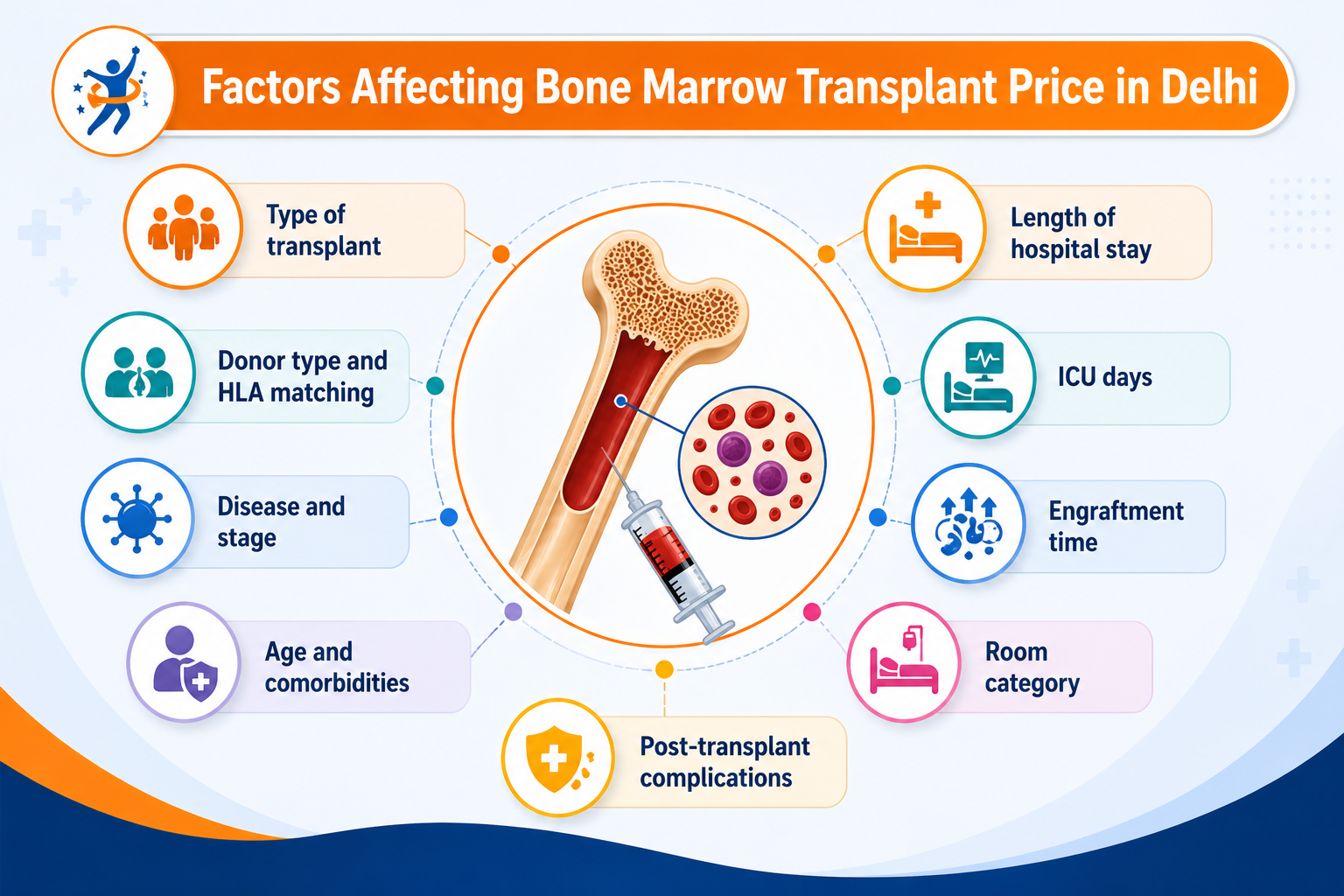
What Affects the Final Bone Marrow Transplant Price in Delhi?
Two patients with the same diagnosis can end up with very different bills. The variables that move the number:
- Type of transplant: Autologous is the cheapest, MUD is usually the most expensive.
- Donor type and HLA matching: Matched sibling is the lowest-cost donor scenario; unrelated registry donors add procurement fees.
- Disease and stage: Relapsed disease often needs more chemotherapy and longer ICU support.
- Age and comorbidities: Older patients or those with organ issues need more supportive care.
- Length of hospital stay: The standard inpatient BMT stay is 4 to 6 weeks. Every additional week adds to the cost.
- ICU days: Sepsis, GVHD, or veno-occlusive disease can extend ICU stays and raise the bill significantly.
- Room category: Single rooms, deluxe rooms, and suites are priced differently.
- Antimicrobials and blood products: Antifungals, IVIG, platelet and packed cell transfusions vary patient to patient and add up quickly.
- Engraftment time: Slower engraftment means longer hospitalisation.
- Post-transplant complications: Managed within the package up to a point, then billed separately.
This is why a single-quoted figure is misleading. A responsible BMT centre will give you a base package price plus a clear list of what is not included.
What’s Included in Dr. Satyendra Katewa’s BMT Package?
A typical bone marrow transplant performed by Dr. Satyendra Katewa covers most of the predictable costs.
Included:
- Pre-transplant work-up (HLA typing for patient and donor, infectious disease screening, organ function tests, dental and ENT clearance)
- Donor harvest (bone marrow harvest or peripheral blood stem cell collection)
- Conditioning chemotherapy
- Stem cell infusion
- Inpatient stay in the BMT unit (HEPA-filtered isolation room, typically 4 to 6 weeks)
- Standard antimicrobial prophylaxis
- Routine blood product support (within defined limits)
- BMT physician and nursing care
- Engraftment monitoring
- A defined post-transplant outpatient follow-up window (usually 100 days)
Usually billed separately or above package limits:
- Extended ICU stays beyond a defined cap
- High-cost antifungals beyond the package allowance
- Immunoglobulin (IVIG) beyond standard dosing
- Repeated platelet or red cell transfusions beyond the cap
- CMV, EBV, adenovirus PCR monitoring beyond protocol
- CAR-T or speciality cellular therapies
- Donor lymphocyte infusion (DLI) if needed later
- Treatment of major complications such as severe GVHD or VOD
Always ask for the package inclusion sheet in writing before admission.
Insurance, EMI, and Government Schemes for BMT
BMT is a major financial event for most Indian families. There are several routes to manage it.
- Health insurance. Most major Indian health insurers cover bone marrow transplant under their critical illness or hospitalisation benefit, but with caveats. Sub-limits often apply (some policies cap BMT at ₹10 -15 lakh), pre-existing disease waiting periods are common, and donor expenses are sometimes excluded.
- Ayushman Bharat (PM-JAY). Eligible families can avail a bone marrow transplant under PM-JAY, though coverage varies by state and empanelled hospital. Max Hospital’s BMT empanelment status under PM-JAY changes over time, so confirm with the BMT coordinator before planning.
- CGHS. Central Government Health Scheme beneficiaries can avail BMT at CGHS-empanelled rates. Max Hospital is empanelled with CGHS for several procedures. CGHS rates are typically lower than the cash counter rates, but pre-authorisation is needed.
- EMI and medical loans. Healthcare financing partners (Bajaj Finserv, ArogyaFinance, Letsmd) offer no-cost EMI on the patient share, with tenures of 12 to 60 months.
- Crowdfunding. For children with thalassemia, sickle cell disease, or rare immunodeficiencies, platforms like Ketto, ImpactGuru, and Milaap have helped families bridge the gap. Dr. Katewa’s team can connect you with patient support organisations that have run successful campaigns.
Bone Marrow Transplant Cost in Delhi for International Patients
Max Hospital is one of the major BMT destinations for patients from Bangladesh, Nepal, Iraq, Afghanistan, the GCC, and African nations. International packages are quoted in USD and usually include airport pickup and drop, medical visa invitation letter, translator support (Bangla, Arabic, Russian, French, where available), accommodation guidance for attendants, and daily care updates to the family.
Bone Marrow Transplant cost in Delhi for international patients typically range from $20,000 to $55,000. Compared with Western countries, bone marrow transplants in India are significantly more affordable, making Delhi a preferred destination for international patients.
About Dr. Satyendra Katewa
Dr. Satyendra Katewa is the Director of Hemato-Oncology and Bone Marrow Transplant (Paediatric Oncology) at Max Hospital, with over two decades of experience.
Training and credentials:
- MBBS – Sardar Patel Medical College, Bikaner
- DNB Paediatrics – Sir Ganga Ram Hospital, New Delhi
- Fellowship in Pediatric Haematology-Oncology and BMT – Indian Academy of Pediatrics, Sir Ganga Ram Hospital
- Fellowship in Pediatric Haematology-Oncology and BMT – Hospital for Sick Children, University of Toronto, Canada
- Observership in Primary Immunodeficiency and BMT – Cincinnati Children’s Hospital, USA
- CRISPR Certification – Harvard University
Memberships: American Society of Bone Marrow Transplantation (ASBMT), European Society for Immunodeficiencies (ESID), Indian Academy of Paediatrics, International Society of Paediatric Oncology (SIOP).
He is recognised as a pioneer of haploidentical and T-cell-depleted pediatric BMT in India, with peer-reviewed publications in Pediatric Blood & Cancer, Journal of Pediatric Haematology/Oncology, and Blood.
Read Dr. Katewa’s full profile →
Why Choose Dr. Satyendra Katewa for Bone Marrow Transplant in Delhi
- Over 20 years of experience in treating complex pediatric blood disorders
- Expertise in haploidentical and high-risk bone marrow transplants
- Leads the BMT program at Max Hospital, known for advanced transplant care
- Internationally trained in Canada & USA with global exposure
- Focus on safe transplant protocols, infection control, and better recovery outcomes
Get a Personalised BMT Cost Estimate
The numbers on this page are realistic ranges, not your final bill. For a written estimate based on your or your child’s specific diagnosis, donor situation, and insurance, request a consultation with Dr. Satyendra Katewa.
- Phone / WhatsApp: 8796133343
- Email: drsatyendrakatewa1@gmail.com
- Book Appointment: https://drsatyendrakatewa.com/book-appointment
- Video consultation: Available for outstation and international patients
Bring with you, if available: latest blood reports, bone marrow aspiration/biopsy reports, HLA typing reports of patient and family, prior treatment summary, and any imaging.
Disclaimer: The cost ranges mentioned are indicative and may vary based on the patient’s medical condition, donor type, complications, and hospital stay. A final estimate is provided after detailed evaluation.
Frequently Asked Questions
What is the average cost of a bone marrow transplant in Delhi? expand_more
The average cost of a bone marrow transplant in Delhi ranges from ₹15,00,000 to ₹45,00,000, depending on the transplant type, donor match, and hospital.
How many days does it take to recover after a bone marrow transplant in Delhi? expand_more
Initial recovery takes around 4 to 6 weeks in the hospital, while full recovery may take 3 to 6 months depending on the patient’s condition.
What is the success rate of bone marrow transplant in Delhi? expand_more
The success rate ranges from 70% to 90% in leading hospitals, depending on the disease, donor compatibility, and patient health.
Which type of bone marrow transplant is cheapest? expand_more
Autologous transplant (using the patient’s own cells) is usually the least expensive compared to donor-based transplants.
Can bone marrow transplant cure leukemia? expand_more
Yes, bone marrow transplant can cure certain types of leukemia, especially when performed at an early stage with a suitable donor.
Is Delhi a good place for bone marrow transplant? expand_more
Yes, Delhi offers advanced BMT centres, experienced specialists, and cost-effective treatment compared to many countries.
How soon can I return to normal life after BMT? expand_more
Most patients can resume normal activities within 3 to 6 months after recovery.

Dr. Satyendra Katewa's Medical Content Team
Dr. Satyendra Katewa’s medical content team specialises in developing accurate, evidence-based, and patient-focused healthcare content. With strong clinical insight and expertise in medical writing and SEO, the team simplifies complex haematology and oncology information into clear, trustworthy resources that support informed decision-making and reflect Dr. Katewa’s commitment to ethical, compassionate care.
This content is reviewed by Dr. Satyendra Katewa
Related Cost Information

Leukaemia Treatment Cost in Delhi

BMT Cost for Thalassemia in India
Thalassemia is an inherited blood condition that affects the body’s ability to produce healthy, functional hemoglobin, leading to anaemia, pale…

Haploidentical Bone Marrow Transplant Cost in Delhi
The haploidentical bone marrow transplant cost in Delhi typically ranges from ₹25 lakh to ₹40 lakh, depending on the child’s…

CAR T Cell Therapy Cost in Delhi
Learning that you or your child needs CAR T cell therapy can be overwhelming, and concerns about treatment costs can…
Bone Marrow Transplant Cost in India
The bone marrow transplant cost in India generally ranges from ₹15 lakh to ₹40 lakh, depending on the type of…

Stem Cell Transplant Cost in Delhi
Stem cell transplant (hematopoietic cell transplant, or HCT) at Dr. Satyendra Katewa’s practice in Delhi ranges from ₹10,00,000 to ₹35,00,000, depending…
Related Articles

Leukaemia Rash in Children: What It Looks Like and When to Get It Checked
Most rashes in children come from viral infections, allergies, or skin irritation, and clear without…
Read Article →
Normal Toddler Bruising vs Leukaemia Bruising: When to Worry
Bruises are common in toddlers. As children learn to walk, run, climb and explore, minor…
Read Article → WhatsApp