
Aplastic Anaemia Treatment in Delhi
Aplastic anaemia is a bone marrow failure condition in which the body stops producing enough red blood cells, white blood cells, and platelets. It’s serious, but with the right specialist, most children respond well to treatment. Options range from immunosuppressive therapy to bone marrow transplant, depending on how severe it is.
If your child shows persistent fatigue, frequent infections, or unexplained bruising, get a paediatric haemato-oncologist involved early. Timing matters.
Reach Out for Expert Care
Introduction
Your child’s blood test comes back with numbers that don’t look right. The doctor says “aplastic anaemia,” and suddenly everything else in the room goes quiet.
If that’s where you are right now, take a breath.
Aplastic anaemia treatment in Delhi has advanced significantly. At specialised centres like Max Super Speciality Hospital, Patparganj, children with this condition are receiving care that follows global standards. Many go on to live healthy, normal lives.
Families need clear information, not just reassurance. This page explains what aplastic anaemia is, how it’s diagnosed, what treatment actually involves, and what questions you should be asking your doctor.
What Is Aplastic Anaemia?
Aplastic anaemia is a bone marrow failure condition. The bone marrow stops producing enough blood cells of all three types: red blood cells, white blood cells, and platelets. This happens because stem cells inside the bone marrow are damaged or destroyed.
It’s not the same as ordinary iron-deficiency anaemia. In aplastic anaemia, the problem isn’t just low haemoglobin. The entire blood-making system has broken down. The body runs short of the cells it needs to carry oxygen, fight infections, and stop bleeding.
Without treatment, severe aplastic anaemia can be life-threatening. With early diagnosis and the right care, the outlook is far better.
Aplastic anaemia can be acquired (it develops during a child’s lifetime) or inherited (passed down through genes). Acquired forms are more common in children, and many cases in India are classified as idiopathic, meaning no clear cause is found.
What Causes Aplastic Anaemia in Children?
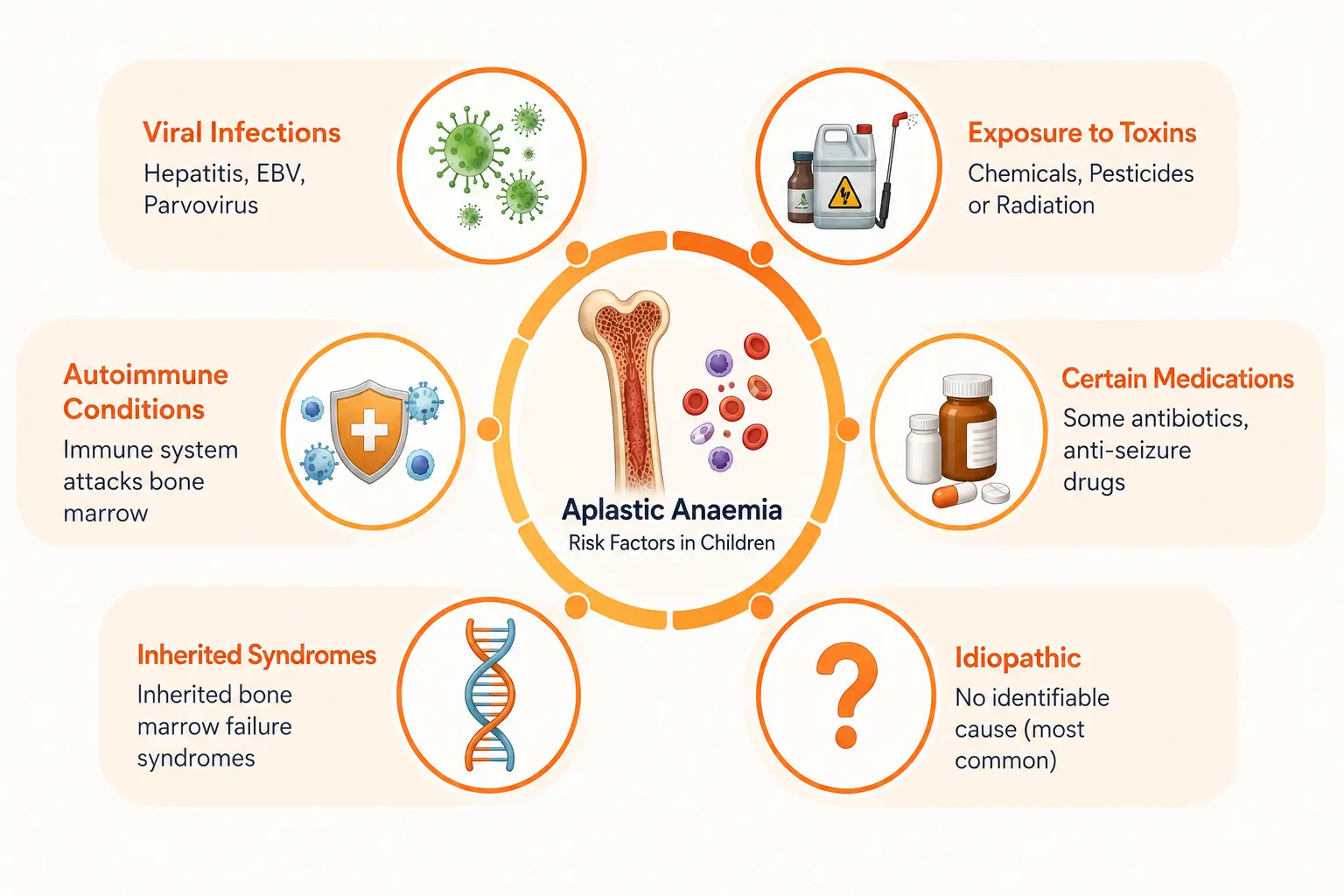
In most cases, aplastic anaemia happens because the immune system mistakenly attacks the body’s own bone marrow stem cells. This is why it’s treated with immunosuppressing medicines.
Several triggers can set this off. Viral infections like hepatitis B, hepatitis C, Epstein-Barr virus, and parvovirus B19 are common culprits. Some children develop aplastic anaemia after a hepatitis episode that seemed to resolve.
In India specifically, research has also linked aplastic anaemia in children to pesticide and organochlorine exposure, which is worth knowing if your child has had significant environmental exposure.
Inherited conditions can also increase the risk. These include Fanconi anaemia, dyskeratosis congenita, and Shwachman-Diamond syndrome. These are rare, but a specialist will rule them out early because they need different management.
Aplastic Anaemia Risk Factors in Children:
- Viral infections (hepatitis, EBV, parvovirus)
- Exposure to certain chemicals, pesticides, or radiation
- Autoimmune conditions
- Certain medications (some antibiotics, anti-seizure drugs)
- Inherited bone marrow failure syndromes
- Idiopathic (no identifiable cause, which is the most common scenario)
Warning Signs Parents Should Not Ignore
This is where most families lose time.
Aplastic anaemia symptoms in children look a lot like the ordinary illnesses parents see all the time. A tired child. Pale skin. Another fever. The reason it gets missed early is that no single symptom shouts “bone marrow failure.”
What you’re looking for is a pattern.
- Fatigue that doesn’t go away: Not the tiredness that follows a long day at school. The tired children stop wanting to play, lose energy quickly, and look washed out most of the time. This happens because low red blood cell levels mean less oxygen reaches the body’s tissues.
- Pale skin or pale nail beds: Parents often notice this first on the face and lips. It’s a sign of low haemoglobin, which is also a feature of general anaemia. When it’s accompanied by other symptoms, it deserves urgent attention.
- Infections that keep coming back: Recurrent fevers, chest infections, or mouth ulcers that don’t clear up properly signal low white blood cell counts. The immune system can’t do its job without enough white cells.
- Easy bruising or unusual bleeding. Bruises from minor bumps. Nosebleeds that take too long to stop. Bleeding gums. These point to low platelets, the cells responsible for clotting.
- Bone or joint pain. Children may complain of aches in the legs or arms, sometimes dismissed as growing pains. Persistent unexplained pain should be investigated.
Symptoms that last more than two to three weeks, or appear together, need a proper blood count done without delay. Trust your instinct as a parent. If something doesn’t feel right, get it checked.
How Is Aplastic Anaemia Diagnosed?
The diagnostic workup for aplastic anaemia starts with a complete blood count and ends with a bone marrow biopsy. Both are needed. Neither alone gives the full picture.
A complete blood count (CBC) shows low levels across all three cell types: haemoglobin, white blood cells, and platelets. This pattern is called pancytopenia, and it’s what alerts the doctor that the bone marrow itself may be failing.
From there, the workup typically includes:
- Peripheral blood smear: A sample of blood is examined under a microscope to study the shape and size of blood cells.
- Bone marrow aspiration and biopsy: These tests confirm the diagnosis. A small sample of bone marrow is taken, usually from the hip. In aplastic anaemia, the marrow is largely replaced by fat cells, with very few blood-forming cells remaining.
- Genetic testing and PNH clone screening: These rule out inherited bone marrow failure syndromes like Fanconi anaemia. They also check for paroxysmal nocturnal haemoglobinuria (PNH), a related condition that occasionally appears alongside aplastic anaemia.
- Reticulocyte count and iron studies: These help rule out other causes of low haemoglobin.
A thorough medical evaluation for aplastic anaemia also includes reviewing family history, asking about medication use, and checking for recent viral illnesses. All of this shapes the treatment plan.
What Are the Treatment Options for Aplastic Anaemia in Delhi?
Aplastic anaemia treatment in Delhi follows two main paths: immunosuppressive therapy (IST) for children without a matched donor, or bone marrow transplant (BMT) for those who have one. For mild cases, supportive care alone may be enough while a more comprehensive assessment is conducted.
The right choice depends on the severity of the condition, whether a matched donor is available, and the child’s age and overall health.
Supportive Care
This is usually the first step while a treatment plan is being confirmed. It includes blood transfusions to correct low haemoglobin and platelet transfusions to reduce bleeding risk. Antibiotics are given to manage infections due to the low white cell count. Supportive care isn’t a cure. It stabilises the child while the definitive treatment plan is put in place.
Immunosuppressive Therapy (IST)
For children without a matched sibling donor, IST is the standard first-line treatment. It uses anti-thymocyte globulin (ATG) combined with cyclosporine to suppress the immune attack on the bone marrow.
IST isn’t a one-time treatment. Children typically stay on cyclosporine for 18 months to two years. They need regular monitoring during this period. Some children relapse and need further therapy.
Bone Marrow Transplant
For children with a matched sibling donor, bone marrow transplant in Delhi is the preferred first-line treatment. It’s the only option with a genuine chance of a permanent cure.
For children without a sibling match, matched unrelated donor transplants and haploidentical (half-matched family member) transplants are also viable options today.
Bone Marrow Transplant for Aplastic Anaemia: What Families Need to Know
Not every child with aplastic anaemia needs a bone marrow transplant straight away butit’s important to understand when it’s the right call, because delaying a necessary transplant works against the outcome.
When is a BMT recommended?
In children with severe or very severe aplastic anaemia and a matched sibling donor, transplant is recommended as first-line therapy rather than IST. The long-term data is better. IST can lead to relapse or, in a small number of cases, late complications like myelodysplastic syndrome (MDS). A successful transplant eliminates that risk.
For children without a sibling match, IST is usually tried first. If it doesn’t produce a good response, a matched unrelated donor or haploidentical transplant is considered.
Types of donors:
- Matched sibling donor (best outcomes, first choice)
- Matched unrelated donor (strong second option)
- Haploidentical donor (a half-matched family member, increasingly used)
Aplastic Anaemia Treatment Cost in Delhi
Cost is one of the first things families want to understand.
Depending on the treatment required, aplastic anaemia treatment cost in Delhi generally ranges from ₹10,000 to ₹30,000 for supportive care and ₹2,00,000 to ₹4,00,000 for a full course of immunosuppressive therapy. Bone marrow transplant costs vary more widely, since they depend on donor type. Matched sibling donor transplants tend to cost less, while matched unrelated donor or haploidentical transplants, more commonly needed when no sibling match is available, tend to cost more.
For a detailed cost breakdown by transplant type, visit the bone marrow transplant cost in Delhi page. A personalised estimate is best discussed during consultation with Dr. Katewa’s team.
Why Choose Dr. Satyendra Katewa for Aplastic Anaemia Treatment in Delhi?
Aplastic anaemia in children is not a common condition. It needs someone who has seen it many times, has the diagnostic instincts to grade it correctly, and has the clinical infrastructure to deliver the right treatment.
With over 25 years of experience in paediatric haemato-oncology, more than 1,000 successful bone marrow transplant cases, Dr. Satyendra Katewa is one of Delhi’s most experienced specialists in childhood blood disorders.
He leads the Paediatric Haemato-Oncology and BMT programme as Director at Max Super Speciality Hospital, Patparganj. This is a fully equipped tertiary care centre with dedicated BMT infrastructure, advanced diagnostic labs, specialised critical care, and a multidisciplinary team.
What families consistently say after their consultations is that they felt heard and that the path forward was explained to them clearly. That matters when you’re trying to make a major medical decision for your child.
If your child has been diagnosed with aplastic anaemia, or if investigations are pointing in that direction, a specialist consultation is the right next step.
Take the Next Step for Aplastic Anaemia Treatment
Three things to take away from this:
- First, aplastic anaemia is serious but treatable. With the right care and the right timing, most children do well.
- Second, early specialist involvement changes outcomes. The sooner the correct diagnosis is confirmed and severity graded, the faster the right treatment can begin.
- Third, you don’t have to figure this out alone. Families in Delhi have access to paediatric BMT expertise that meets global standards.
Book a consultation with Dr. Satyendra Katewa at Max Super Speciality Hospital, Patparganj or fill in the contact form at drsatyendrakatewa.com.
Frequently Asked Questions
Is aplastic anaemia treatment available in India? expand_more
Yes, aplastic anaemia treatment in India includes immunosuppressive therapy and bone marrow transplant, available under specialists like Dr. Satyendra Katewa at Max Super Speciality Hospital, Patparganj. Treatment follows internationally recognised protocols.
What is severe aplastic anaemia? expand_more
Severe aplastic anaemia is a classification based on how low a child's blood counts are, and it usually requires more urgent treatment than milder forms of the condition. Children with severe or very severe aplastic anaemia and a matched sibling donor are often considered for bone marrow transplant as first-line treatment
What are the possible complications of aplastic anaemia? expand_more
Complications of aplastic anaemia can include serious infections, bleeding problems, and in some cases, relapse or a rare late condition called myelodysplastic syndrome (MDS). Regular monitoring after treatment helps catch these complications early.
What is the prognosis for aplastic anaemia in children? expand_more
The prognosis for aplastic anaemia in children has improved with modern treatment, and many children go on to live healthy lives. Outcomes depend on disease severity, how quickly treatment begins, and whether a matched donor is available for transplant.
What does idiopathic aplastic anaemia mean? expand_more
Idiopathic aplastic anaemia means the exact cause of the bone marrow failure cannot be identified, even after thorough testing. This is actually the most common scenario in children diagnosed with the condition.

Dr. Satyendra Katewa's Medical Content Team
Dr. Satyendra Katewa’s medical content team specialises in developing accurate, evidence-based, and patient-focused healthcare content. With strong clinical insight and expertise in medical writing and SEO, the team simplifies complex haematology and oncology information into clear, trustworthy resources that support informed decision-making and reflect Dr. Katewa’s commitment to ethical, compassionate care.
This content is reviewed by Dr. Satyendra Katewa
Related Blogs

Normal Platelet Count in Children: Range, Low Levels and When to Worry
A blood test can raise questions when your child’s platelet count falls outside the normal…
Read Article → WhatsApp