Targeted Therapy in Delhi
Targeted therapy is a precision cancer treatment that attacks specific genetic mutations or proteins driving cancer growth, while largely sparing healthy cells. It is used by Dr. Satyendra Katewa at Max Healthcare, Patparganj, Delhi, for blood cancers including CML, ALL, AML, and lymphoma, as well as select solid tumours.
Treatment is often taken as an oral tablet at home. Eligibility requires molecular testing first. If your child or a family member has been diagnosed, book a consultation to find out whether targeted therapy is the right option.
Reach Out for Expert Care
Introduction
Most parents facing a childhood leukaemia diagnosis ask the same question: Does my child have to go through all of chemotherapy? In many cases today, the answer has changed. Targeted therapy for blood cancer in Delhi has made it possible to treat certain cancers with drugs that work with precision, attacking the specific genetic changes driving the cancer, not everything in their path.
Dr. Satyendra Katewa, Director of Pediatric Haemato-Oncology and BMT at Max Healthcare, Patparganj, has more than 25 years of experience treating children and adults with blood cancers and blood disorders. His approach to targeted therapy in Delhi combines detailed molecular testing with internationally guided treatment protocols, ensuring every patient receives a plan tailored to their specific cancer biology, not a standard template.
This page explains what targeted therapy is, who it is right for, what the process looks like, what the research says about outcomes, and how to take the first step.
What Is Targeted Therapy for Cancer?
Targeted therapy uses drugs that identify and attack specific proteins, genes, or molecular signals that cancer cells rely on to grow and survive. Unlike chemotherapy, which damages all rapidly dividing cells, targeted drugs are designed to interfere with the biology that makes a particular cancer behave the way it does, leaving most healthy cells alone.
These drugs work in several ways. Some block the signals that tell cancer cells to keep dividing. Others cut off the blood supply that tumors need to grow. Some deliver toxic substances directly to cancer cells using antibodies as carriers. Others trigger cancer cells to die in the way normal, damaged cells are supposed to.
The result is a more focused treatment. Most patients on oral targeted therapy continue their daily lives, children stay in school, and adults return to work while undergoing treatment. That’s a meaningful shift from the intensive, in-hospital experience that traditional chemotherapy treatment often requires.
Targeted therapy doesn’t work for every cancer. It depends entirely on whether the cancer has a specific, identifiable target, which is why molecular testing comes before treatment selection, every time.
Who Is Targeted Therapy Right For?
Targeted therapy is recommended when molecular testing shows that a cancer has specific mutations, protein markers, or gene abnormalities that approved drugs can act on. It’s not a treatment for every cancer type, but for the cancers it suits, it can produce significantly better outcomes than chemotherapy alone.
Dr. Katewa uses target therapy most often for:
- Chronic myeloid leukaemia (CML) – driven by the BCR-ABL gene fusion, which is directly targeted by tyrosine kinase inhibitors (TKIs) such as imatinib and dasatinib
- Acute lymphoblastic leukaemia (ALL)– particularly cases with specific gene translocations such as KMT2A rearrangements
- Acute myeloid leukaemia (AML) – in cases where FLT3, IDH1/2, or BCL-2 mutations are identified
- Hodgkin and non-Hodgkin lymphoma – where CD20 or CD30 targets are present
- Multiple myeloma and gastrointestinal stromal tumours (GIST)
- Select solid tumours with HER2, EGFR, or ALK mutations
It’s also a strong option when blood cancer has relapsed after first-line treatment, or when standard chemotherapy hasn’t produced the expected response.
Dr. Katewa’s paediatric expertise is particularly important here; dosing, monitoring thresholds, and side-effect management in children differ meaningfully from adult protocols. For international patients, Max Healthcare, Patparganj, offers coordinated support from pre-arrival planning through to post-treatment follow-up via telemedicine.
What Tests Do You Need Before Starting Targeted Therapy?
Before any targeted drug can be prescribed, molecular testing must confirm that the cancer has a targetable abnormality. There is no standard shortcut here; testing is the foundation of the entire treatment plan.
Next-Generation Sequencing (NGS) – identifies gene mutations and fusions across multiple cancer-relevant genes in a single assay, now recommended as standard of care by ESMO Precision Medicine Working Group (2024)
PCR testing – detects specific gene rearrangements like BCR-ABL in CML
FISH (fluorescence in situ hybridisation) – identifies chromosomal abnormalities
Immunohistochemistry (IHC) – identifies protein markers like CD20, HER2, or PD-L1 on cancer cells
Bone marrow aspiration and biopsy – assesses disease burden directly for blood cancers
Liquid biopsy (circulating tumour DNA) – used for monitoring treatment response in select cases
CT, MRI, or PET-CT imaging – establishes baseline tumour location and extent
Blood panel – checks organ function before treatment begins
The full diagnostic workup typically takes 1-3 weeks. Results are reviewed in a multidisciplinary setting, and treatment planning follows directly.
Step-by-Step: How Targeted Therapy Works
Step 1: Initial Consultation and Molecular Profiling
Full review of medical history, previous treatments, current health status, and symptoms. Tissue or blood is sent for molecular profiling. For children, Dr. Katewa reviews the case in the context of paediatric-specific dosing needs and developmental considerations.
Step 2: Treatment Planning
Once results are available, a personalised treatment plan is built: which drug has been selected and why, whether it will be given orally at home or by IV infusion, whether combination with chemotherapy or immunotherapy is indicated, expected duration, and a clear side-effect management plan.
Step 3: Treatment Administration
Many targeted drugs are oral tablets taken once or twice daily at home, fewer hospital visits and a more manageable routine for families. Some targeted drugs, including monoclonal antibodies, are given as IV infusions at the clinic on a scheduled cycle basis.
Step 4: Ongoing Monitoring
Blood tests every 2 to 4 weeks check organ function and treatment response. Imaging every 8 to 12 weeks assesses tumor burden. For leukemia patients, repeat molecular testing tracks genetic-level response. For CML patients on TKIs, treatment-free remission is an achievable goal for some.
Step 5: Long-Term Management
After the active treatment phase, surveillance continues. For children, this includes monitoring for growth and developmental considerations alongside cancer markers. Psychological support for children and families is part of the care pathway.
If the cancer returns, targeted therapy can often be restarted. Resistance to one TKI does not necessarily mean there are no further options; second and third-generation drugs exist for most blood cancer types. For patients who develop resistance to targeted agents, CAR T cell therapy or bone marrow transplant may be the next step.
How Safe Is Targeted Therapy, and What Are the Side Effects?
Targeted therapy generally produces fewer and less severe side effects than chemotherapy, particularly for the effects families dread most. Hair loss and bone marrow suppression are uncommon with most targeted drugs. Nausea is milder, and most patients do not require anti-sickness medication routinely.
Common side effects with TKIs (manageable):
- Skin rash and dryness
- Mild diarrhoea
- Mild nausea
- Fatigue
- Changes in liver enzymes (monitored at every follow-up)
Less common but monitored closely:
- Raised blood pressure (with VEGF-inhibiting drugs)
- Heart rhythm changes — regular ECG monitoring is part of the protocol
- Liver toxicity (rare — detected early through scheduled blood tests)
- Bleeding or clotting changes (rare)
- Bone growth and height trajectory in children on long-term treatment
The side-effect profile is manageable for the great majority of patients. Most children and adults on oral targeted therapy maintain a near-normal quality of life during treatment.
Success Rates of Targeted Therapy
| Cancer Type | Treatment Approach | Key Outcomes | What It Means for Patients |
|---|---|---|---|
| Chronic Myeloid Leukaemia (CML) | Targeted therapy using Tyrosine Kinase Inhibitors (TKIs) | ~90% 10-year survival (vs ~20% before TKIs) | Targeted therapy has dramatically improved long-term survival in CML |
| Paediatric CML | TKIs as standard treatment |
>92% 5-year survival |
Most children respond well and live long-term with proper treatment |
| High-Risk Paediatric Cancers | Molecularly guided targeted therapy | 36% objective response rate | Over 1 in 3 patients showed a measurable tumour response |
| Relapsed / Resistant Cancers |
Precision oncology based on molecular profiling |
Improved outcomes compared to standard therapy | Helps identify treatment options when conventional therapies fail |
Note:
- Success rates depend on cancer type, genetic mutation, stage, and overall health
- Targeted therapy is most effective when matched precisely to the tumour’s biology
- Treatment outcomes vary from patient to patient
In clinical practice, Dr. Satyendra Katewa evaluates each patient’s molecular profile to provide realistic expectations and the most appropriate targeted therapy plan.
Targeted Therapy vs Chemotherapy: What’s the Difference?
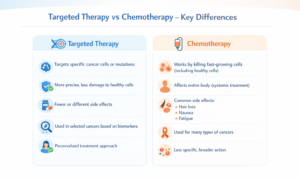
Neither approach is universally better. Many patients receive both targeted drugs alongside chemotherapy, particularly in high-risk ALL or AML. In CML, a targeted drug alone is now the standard first-line treatment for most patients.
The decision depends entirely on the cancer’s molecular profile. For some cancers, there is no targetable mutation, and chemotherapy remains the right path. For others, targeted therapy is the most effective, best-tolerated option available.
Dr. Katewa reviews each case individually, presenting the options with clear explanations of what the evidence shows for that specific cancer type and mutation profile.
Why Choose Dr. Satyendra Katewa for Targeted Therapy in Delhi?
When it comes to advanced, personalised cancer care, Dr. Satyendra Katewa stands out as a leading expert in targeted therapy for blood cancers in Delhi. As Director of Paediatric Haemato-Oncology and BMT at Max Healthcare, Patparganj, he brings over 25 years of experience treating both children and adults with complex blood disorders.
Expertise in Precision & Targeted Treatments
Dr. Katewa specialises in cutting-edge targeted therapies for conditions such as chronic myeloid leukaemia (CML), acute lymphoblastic leukaemia (ALL), acute myeloid leukaemia (AML), and lymphoma. His approach focuses on attacking cancer cells at the molecular level, improving outcomes while minimising side effects.
Advanced Bone Marrow Transplant (BMT) Care
He is highly experienced in bone marrow transplantation, offering life-saving treatment options for patients with high-risk blood cancers and genetic blood disorders.
Personalised, Biology-Driven Treatment Plans
What sets Dr. Katewa apart is his emphasis on precision oncology. By using molecular profiling and biomarker testing, he designs individualised treatment plans tailored to each patient’s unique cancer biology rather than a one-size-fits-all approach.
Specialised Care for Children and Adults
With deep expertise in paediatric haemato-oncology, he is especially known for treating childhood leukaemia and lymphoma, while also managing adult cases with equal proficiency.
Global Standards with Local Accessibility
Dr. Katewa follows internationally recognised treatment protocols and offers seamless care for international patients, including telemedicine consultations and long-term follow-up.
Choosing Dr. Satyendra Katewa means opting for a combination of experience, advanced technology, and highly personalised care, making him a trusted choice for targeted therapy in Delhi.
Take the First Step
Targeted therapy has changed what’s possible for children and adults diagnosed with blood cancers. For CML, it’s now the standard of care. For relapsed or high-risk leukaemia, molecularly guided targeted therapy offers meaningful improvement in survival even when other treatments have not worked. For solid tumours with specific mutations, it opens treatment paths that didn’t exist a decade ago.
If your child or a family member has been diagnosed with leukaemia, lymphoma, or another blood cancer, the first step is a consultation. Dr. Katewa’s team at Max Healthcare, Patparganj, will review the diagnosis, recommend the appropriate molecular tests, determine whether targeted therapy is appropriate, and outline what to expect realistically.
Fill out the consultation form on this page, call +91 98217 33431, or send a WhatsApp message to book your appointment.

Dr. Satyendra Katewa's Medical Content Team
Dr. Satyendra Katewa’s medical content team specialises in developing accurate, evidence-based, and patient-focused healthcare content. With strong clinical insight and expertise in medical writing and SEO, the team simplifies complex haematology and oncology information into clear, trustworthy resources that support informed decision-making and reflect Dr. Katewa’s commitment to ethical, compassionate care.
This content is reviewed by Dr. Satyendra Katewa
Related Blogs

Best Paediatric Haemato-Oncologists in Delhi
When a child is referred to a cancer or blood disorder specialist, it can be…
Read Article →
Best Treatment Options for Leukaemia in Children
Leukaemia is the most common cancer affecting children. If your child has been diagnosed with…
Read Article →
Recovery After Bone Marrow Transplant in Children
A bone marrow transplant (BMT) is a life-saving treatment for many childhood cancers and blood…
Read Article →
Early Signs of Blood Cancer in Children: What Every Parent Should Know
Seeing your child unwell can make any parent anxious. Most childhood illnesses, such as fever,…
Read Article → WhatsApp