
5-Year-Old Girl Defeats Thalassemia After Successful Half-Match Bone Marrow Transplant in Delhi
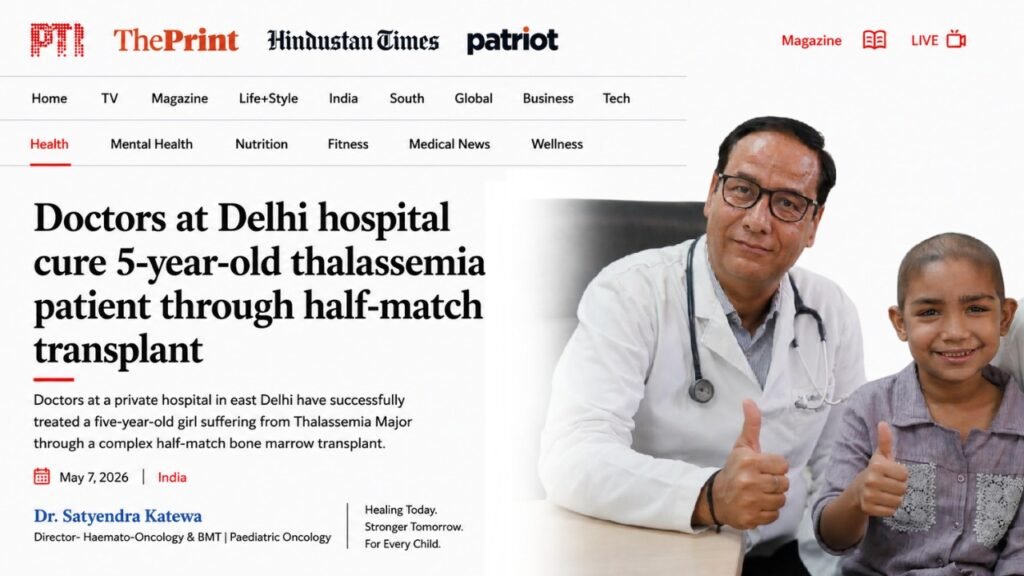
For most children, early childhood is filled with school, playtime, and birthdays. But for Zehra, a five-year-old girl from Jaipur, life revolved around hospitals, blood transfusions, and medical uncertainty. Diagnosed with thalassemia major at just two months of age, she spent years depending on regular blood transfusions to survive.
Today, Zehra is beginning a new chapter, one where she can attend school, play freely, and live without transfusion dependency after successfully undergoing a complex haploidentical (half-match) bone marrow transplant under the care of Dr. Satyendra Katewa at Max Super Speciality Hospital.
Understanding the Challenge: Living with Thalassemia Major
Thalassemia major is a severe inherited blood disorder in which the body cannot produce enough healthy haemoglobin. As a result, children develop severe anaemia and often require lifelong blood transfusions to survive.
For Zehra and her family, this meant:
- Frequent hospital visits
- Repeated blood transfusions
- Physical weakness and fatigue
- Emotional and financial stress
- Fear of long-term complications
According to reports, India carries one of the world’s highest thalassemia burdens, with nearly 10,000 to 15,000 affected children born every year.
Over time, repeated blood transfusions can lead to iron overload, affecting major organs such as the heart, liver, and endocrine system. Experts note that many children with transfusion-dependent thalassemia may develop organ-related complications if long-term treatment continues without a curative option.
The Search for a Cure
Bone marrow transplant (BMT), also called hematopoietic stem cell transplant, is currently considered the only potential curative treatment for thalassemia major.
However, successful transplantation usually requires a fully matched Human Leukocyte Antigen (HLA) donor, often a sibling. Unfortunately, Zehra did not have a fully matched donor in her family.
This presented a major challenge.
In many such cases, families are forced to continue lifelong transfusion therapy because suitable donors cannot be found. But advances in transplant medicine have created another possibility: haploidentical bone marrow transplantation.
What Is a Haploidentical (Half-Match) Bone Marrow Transplant?
A haploidentical transplant uses a donor who shares approximately 50% of the patient’s HLA markers, usually a parent or sibling.
Historically, these procedures were considered more risky because of:
- Higher chances of graft rejection
- Graft-versus-host disease (GVHD)
- Severe infections
- Complex immune recovery
But modern transplant protocols, conditioning regimens, and post-transplant care have significantly improved outcomes in recent years.
According to Dr. Satyendra Katewa, advancements in transplantation techniques have made haploidentical transplants an increasingly safe and effective option for children who lack a fully matched donor.
The Treatment Journey
After careful evaluation, the medical team at Max Super Speciality Hospital decided to proceed with a 50% HLA-matched bone marrow transplant using a partially matched family donor.
The treatment process involved:
- Detailed donor compatibility testing
- Pre-transplant conditioning therapy
- Intensive infection prevention protocols
- Close monitoring during marrow engraftment
- Post-transplant immune management
The procedure was led by Dr. Satyendra Katewa, Director of Pediatric Hemato-Oncology and Bone Marrow Transplant.
Following the transplant, Zehra remained under close medical supervision. Reports indicate that she recovered steadily and was discharged within 28 days of the procedure.
For her family, the recovery represented far more than a medical success; it meant freedom from years of uncertainty.
From Hospital Rooms to Classrooms
One of the most emotional moments in Zehra’s journey came after her recovery, when she was finally able to attend school regularly.
For years, much of her childhood had been spent in hospitals rather than classrooms. Her successful transplant allowed her to move toward a healthier, more normal life.
The case highlights not only the progress in pediatric bone marrow transplantation in India but also the growing role of advanced haploidentical transplant programs in treating complex blood disorders.
Why This Case Matters
Zehra’s recovery carries important lessons for families dealing with thalassemia major:
1. A Fully Matched Donor Is Not Always Necessary
Many patients who do not have a matched sibling donor may still be eligible for a haploidentical transplant.
2. Early Intervention Can Improve Outcomes
Early diagnosis and timely referral to a specialised pediatric BMT centre can significantly improve treatment possibilities.
3. Modern BMT Protocols Have Improved
Advances in infection control, immune suppression, and post-transplant care have made complex transplants safer than before.
4. Awareness Remains Critical
Experts continue to stress the importance of carrier screening, genetic counselling, and early diagnosis to reduce the burden of thalassemia in India.
Understanding Thalassemia Prevention
Medical experts emphasise that thalassemia is a genetic condition passed from parents to children. Increased awareness about carrier screening before marriage or pregnancy can help reduce future cases.
In addition to treatment advances, preventive strategies such as:
- Premarital screening
- Prenatal testing
- Family counselling
- Early HLA typing
can play a major role in reducing the disease’s long-term burden.
A Story of Hope for Families
For parents of children living with thalassemia major, Zehra’s journey offers hope. What once seemed impossible became achievable through advanced transplant medicine, multidisciplinary care, and timely intervention.
Today, instead of living around transfusion schedules, she is stepping into a healthier future, one that includes school, play, and the chance to enjoy childhood beyond hospital walls.
Zehra’s recovery is more than a medical success story; it is a reminder that advances in pediatric bone marrow transplantation are giving new hope to children and families battling thalassemia across India.
Media Coverage & References
This case was featured by multiple national media publications highlighting advancements in pediatric bone marrow transplant and thalassemia treatment in Delhi.

 WhatsApp