
Neuroblastoma in Children
Neuroblastoma is a childhood cancer that develops in immature nerve cells, most commonly in the adrenal glands.
Neuroblastoma is one of the more common solid cancers seen in young children (around 7%-10% of all pediatric cancers), and treatment outcomes today are better than they were even a decade ago. With modern chemotherapy, surgery, stem cell transplant, and newer immunotherapy medicines, many children go on to live healthy, normal lives.
If your child has recently been diagnosed with neuroblastoma, it is natural to feel overwhelmed. This page explains neuroblastoma, its diagnosis, treatment options, recovery, and survival rates clearly.
Reach Out for Expert Care
What Is Neuroblastoma?
Neuroblastoma is a childhood cancer that develops from immature nerve cells called neuroblasts. These cells are part of the developing nervous system in babies and young children.
The cancer most commonly begins in the adrenal glands, which sit above the kidneys, but it can also arise anywhere along the nerve tissue of the chest, abdomen, pelvis, neck, or spine.
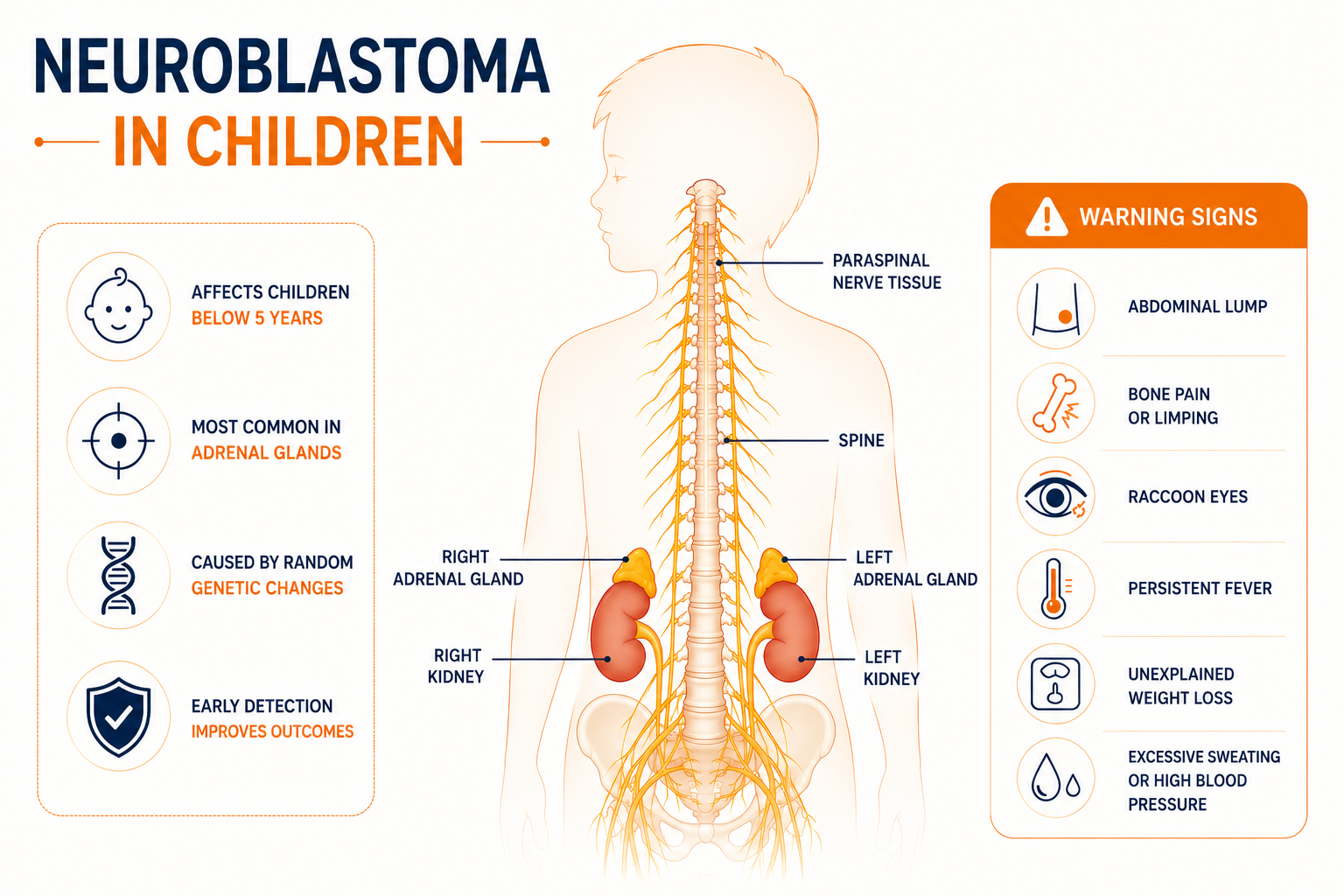
Neuroblastoma primarily affects:
- Infants
- Toddlers
- Children below 5 years of age
The median age at diagnosis is around 19 months.
Some neuroblastomas grow slowly and respond very well to treatment, while others behave aggressively and require intensive therapy. This is why risk classification is extremely important.
When diagnosed early, low-risk neuroblastoma has survival rates exceeding 95%.
Signs and Symptoms of Neuroblastoma
The symptoms of neuroblastoma vary depending on where the tumour begins and whether it has spread.
Early signs are often mistaken for common childhood illnesses, which is why diagnosis can sometimes be delayed.
Common Neuroblastoma Symptoms
- A firm or swollen lump in the abdomen
- Belly pain or fullness
- Bone pain or limping
- Persistent fever without infection
- Fatigue or unusual weakness
- Weight loss or poor appetite
- Irritability in infants
- Back pain or difficulty walking
- High blood pressure or excessive sweating
- Constipation or urinary symptoms
Neuroblastoma Eyes (“Raccoon Eyes”)
Dark bruising or swelling around the eyes, often called “raccoon eyes,” can occur when neuroblastoma spreads to the bones around the eye socket.
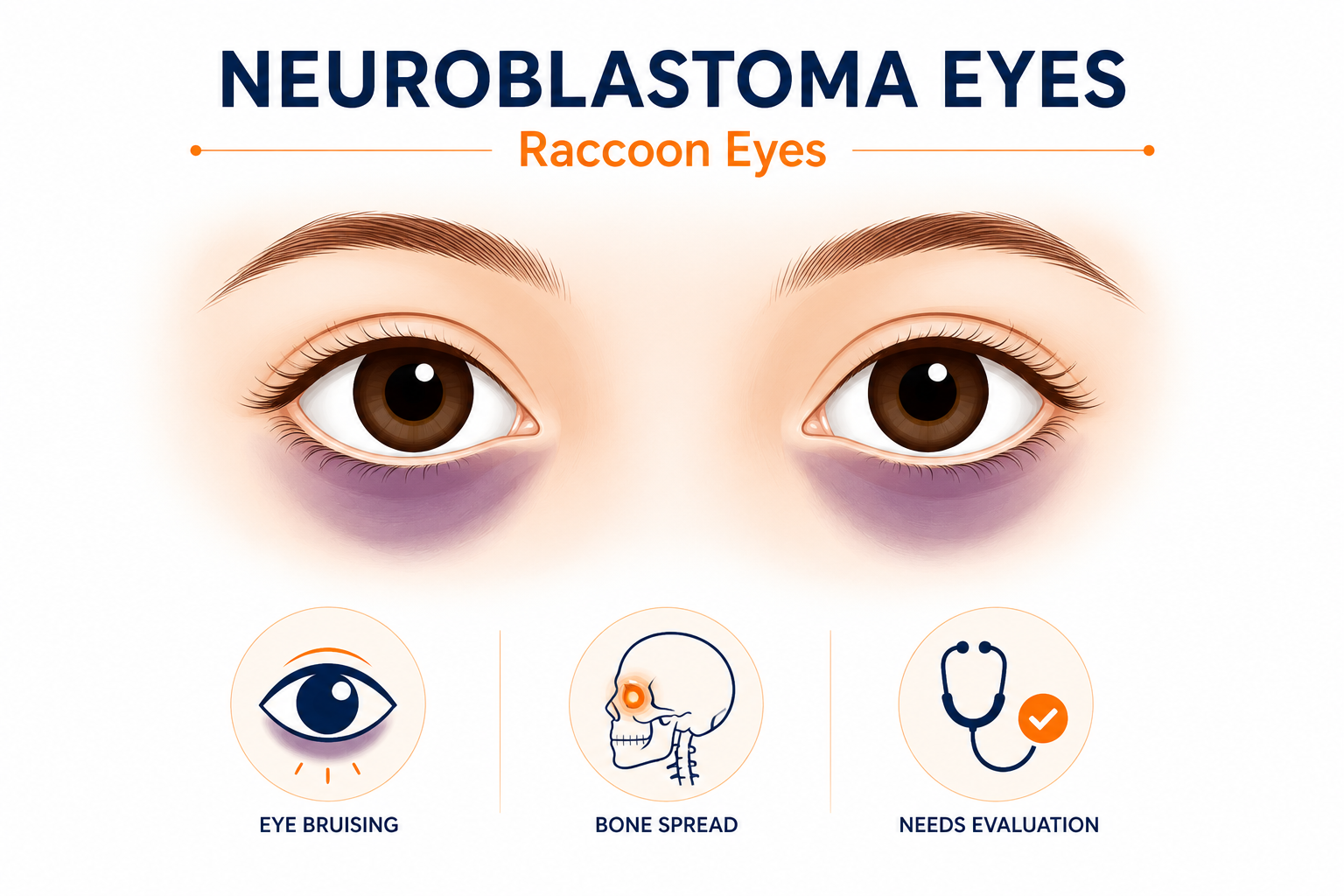
This is an important warning sign and should never be ignored in a young child.
Symptoms of Stage 4 Neuroblastoma
Stage 4 neuroblastoma may cause bone pain, difficulty walking, weight loss and raccon eyes along with low blood counts due to bone marrow involvement.
Even in advanced disease, treatment can still be highly effective in many children.
What Causes Neuroblastoma?
In most children, there is no identifiable cause.
Neuroblastoma develops because of random genetic changes in immature nerve cells during early development.
Only about 1-2% of neuroblastoma cases are hereditary.
Rare inherited forms may involve mutations in genes such as: ALK and PHOX2B
Doctors may also test for tumor biology markers, such as MYCN amplification, which helps determine how aggressive the cancer may be.
How Is Neuroblastoma Diagnosed?
Diagnosing neuroblastoma requires a combination of imaging, laboratory tests, and tissue confirmation.
1. Blood and Urine Tests
Neuroblastoma cells release chemicals called catecholamines, which can be detected in urine tests.
Doctors commonly test for:
- VMA (Vanillylmandelic Acid)
- HVA (Homovanillic Acid)
These markers help support the diagnosis.
2. Imaging Scans
Imaging helps determine:
- Tumour location
- Size
- Organ involvement
- Whether the cancer has spread
Common scans include:
- Ultrasound
- CT scan
- MRI
- MIBG scan
The MIBG scan is considered one of the most important imaging tests in neuroblastoma radiology because it can detect disease spread throughout the body.
3. Biopsy
A biopsy confirms the diagnosis by examining tumour tissue under a microscope.
The biopsy also helps doctors study:
- Tumour biology
- Genetic changes
- MYCN status
- Risk category
4. Bone Marrow Examination
As neuroblastoma commonly spreads to bone marrow, a bone marrow aspiration and biopsy may also be performed.
Neuroblastoma Stages and Risk Groups
Not all neuroblastoma behaves the same way. Treatment decisions depend on:
- The child’s age
- Tumour biology
- Stage of disease
- MYCN amplification status
- Whether the cancer has spread
Low-Risk Neuroblastoma
Survival rate – More than 95%
- Localised tumour
- Favourable biology
- Excellent outcomes
Intermediate-Risk Neuroblastoma
Survival rate – Around 90 – 95%
- Limited spread
- Usually seen in younger children
- Requires moderate-intensity treatment
High-Risk Neuroblastoma (Stage 4)
Survival rate – Approximately 50-60%
- Cancer has spread to bones, bone marrow, liver, or distant lymph nodes
- Requires aggressive multimodal treatment
How Is Neuroblastoma Treated?
Treatment is personalised according to the child’s risk group and overall condition. Dr. Satyendra Katewa develops an individualised treatment plan rather than following a one-size-fits-all approach.
Surgery
Surgery removes the primary tumour whenever safely possible.
For localised neuroblastoma, surgery alone may sometimes be sufficient.
Chemotherapy
Chemotherapy is used to:
- Shrink tumours before surgery
- Destroy microscopic cancer cells
- Treat metastatic disease
Multiple chemotherapy cycles are often required in high-risk neuroblastoma.
Stem Cell Transplant
High-risk neuroblastoma may require an autologous stem cell transplant.
In this procedure:
- The child’s own stem cells are collected
- High-dose chemotherapy is given
- Stem cells are reinfused to restore healthy bone marrow function
This approach improves outcomes in aggressive neuroblastoma.
Radiation Therapy
Radiation may be used:
- After surgery
- For residual disease
- In metastatic or high-risk cases
Immunotherapy for Neuroblastoma
Immunotherapy with dinutuximab helps the immune system recognize and destroy the remaining neuroblastoma cells.
It is now an important part of treatment for high-risk neuroblastoma in many centres worldwide and has improved survival rates.
Neuroblastoma vs Wilms Tumour
Neuroblastoma and Wilms tumour (nephroblastoma) can both appear as abdominal masses in young children, but they are completely different cancers.
| Neuroblastoma | Wilms Tumour |
| Starts in nerve cells | Starts in kidney cells |
| Usually arises from adrenal gland | Arises from kidney |
| Often spreads early | Usually more localised |
| May cause raccoon eyes | Does not cause raccoon eyes |
| Different chemotherapy protocols | Different treatment pathway |
A specialist evaluation and imaging scan can accurately distinguish between the two.
Life After Neuroblastoma Treatment
Many children treated for neuroblastoma grow up to lead healthy and active lives.
Long-term follow-up care may include:
- Regular scans and blood tests
- Growth and development monitoring
- Hearing evaluations
- Heart function assessment
- Hormonal monitoring
- Psychological and emotional support
Some chemotherapy medicines can affect hearing or growth, so survivorship care remains an important part of recovery.
Families are usually given a long-term personalised follow-up plan.
Expert Neuroblastoma Treatment in Delhi
Dr. Satyendra Katewa is a leading paediatric haemato-oncologist and bone marrow transplant specialist with over 25 years of experience treating childhood cancers and complex blood disorders.
He specialises in:
- Childhood cancers
- Bone marrow transplant
- Neuroblastoma treatment
- Leukaemia and lymphoma care
- Stem cell transplant in children
Families across India and internationally consult him for advanced paediatric cancer treatment and second opinions.
Supporting Your Child Through Neuroblastoma
Neuroblastoma is a serious childhood cancer, but treatment outcomes today are better than ever before. Early diagnosis, accurate risk classification, and timely treatment can genuienly improve survival and quality of life.
With advances in surgery, chemotherapy, stem cell transplant, and immunotherapy, many children with neuroblastoma now go on to live healthy and active lives. If your child has persistent abdominal swelling, bone pain, raccoon eyes, or unexplained symptoms, seeking an early specialist evaluation can make a critical difference.
Dr. Satyendra Katewa – Paediatric Haematologist & Bone Marrow Transplant Specialist, New Delhi
Book an Appointment for Expert Evaluation
Whats app us – Request Information About Treatment Options
Frequently Asked Questions
At what age does neuroblastoma usually occur? expand_more
Most children are diagnosed before the age of 5 years. It is especially common in infants and toddlers.
Is neuroblastoma curable? expand_more
Yes. Many children with low-risk neuroblastoma are cured completely. Even high-risk neuroblastoma outcomes are improving steadily with modern treatment.
Is neuroblastoma hereditary? expand_more
Only a very small percentage of cases are inherited. Most occur randomly without family history.
What are raccoon eyes in neuroblastoma? expand_more
Raccoon eyes refer to dark bruising around the eyes caused by tumour spread to the bones around the eye socket.
Is stem cell transplant necessary in neuroblastoma? expand_more
Stem cell transplant is usually recommended for high-risk neuroblastoma as part of intensive treatment.

Dr. Satyendra Katewa's Medical Content Team
Dr. Satyendra Katewa’s medical content team specialises in developing accurate, evidence-based, and patient-focused healthcare content. With strong clinical insight and expertise in medical writing and SEO, the team simplifies complex haematology and oncology information into clear, trustworthy resources that support informed decision-making and reflect Dr. Katewa’s commitment to ethical, compassionate care.
This content is reviewed by Dr. Satyendra Katewa
 WhatsApp