
Lymphoma in Children – Types, Symptoms & Treatment in Delhi
Lymphoma is the third most common cancer in children, and with timely diagnosis and modern treatment, it is also one of the most curable childhood cancers. Parents searching for answers about childhood lymphoma often feel overwhelmed, but pediatric lymphoma responds well to structured treatment when caught early.
This page covers the types, symptoms, causes, diagnosis, staging, and treatment of lymphoma in children, along with what parents should know about finding the right pediatric cancer specialist in Delhi.
Reach Out for Expert Care
What Is Lymphoma in Children?
Lymphoma in children is a cancer of the lymphatic system, the network of glands and vessels that helps the body fight infection. It develops when white blood cells called lymphocytes grow and divide abnormally, forming tumours in lymph nodes or other lymphatic tissue such as the spleen, thymus, or tonsils.
Childhood lymphoma is broadly divided into two categories:
- Hodgkin lymphoma (HL): Identified by the presence of Reed-Sternberg cells, more common in older children and adolescents.
Click here to read more on Hodgkin lymphoma
- Non-Hodgkin lymphoma (NHL): A more diverse group of lymphomas that tends to occur in younger children and often grows more quickly.
Click here to read more on Non – Hodgkin lymphoma
Under the care of leading pediatric oncologists in Delhi experienced in childhood cancer treatment, both types are highly treatable, especially when identified in the early stages.
Types of Lymphoma in Children
The two main types of lymphoma in children are Hodgkin lymphoma and Non-Hodgkin lymphoma, each with distinct subtypes and treatment pathways.
Hodgkin Lymphoma in Children
Hodgkin lymphoma in children typically begins in the lymph nodes of the neck, chest, or underarms. It tends to spread in a predictable, step-by-step pattern from one lymph node group to the next, which makes staging and treatment planning more straightforward. It is more common in adolescents than in very young children.
Non-Hodgkin Lymphoma in Children
Non-Hodgkin lymphoma in children includes several subtypes:
- Burkitt lymphoma: A fast-growing B-cell lymphoma, one of the most common NHL subtypes in children.
- Lymphoblastic lymphoma: Closely related to acute lymphoblastic leukaemia, often involving the chest or thymus.
- Diffuse large B-cell lymphoma (DLBCL): Can occur in children and adolescents, though more frequent in adults.
- Anaplastic large cell lymphoma (ALCL): A less common subtype that can affect lymph nodes as well as skin and other organs.
Symptoms of Lymphoma in Children
The most common early sign of lymphoma in children is a painless, persistent swelling in the neck, underarm, or groin that does not go away within a few weeks.
Other symptoms parents should watch for include:
- Persistent or unexplained fever
- Drenching night sweats
- Unexplained weight loss
- Ongoing fatigue or low energy
- Enlarged lymph nodes that keep growing rather than shrinking
- Swelling in the abdomen, or a feeling of fullness
- Persistent cough or breathing difficulty (when lymphoma affects the chest)
- Itchy skin without a rash
Many of these symptoms overlap with common childhood infections, which is exactly why lymphoma can be missed early. A lymph node swelling that persists beyond two to three weeks, especially without pain or an obvious infection, warrants evaluation by a pediatric oncologist in Delhi.
Causes and Risk Factors of Childhood Lymphoma
The exact cause of lymphoma in children is not fully understood, but it is believed to result from genetic changes in lymphocytes that are usually not inherited.
Known risk factors include:
- Weakened immune system: Children with congenital or acquired immune deficiencies have a higher risk.
- Epstein-Barr virus (EBV) infection: Linked to a proportion of Hodgkin lymphoma cases.
- Family history: A sibling or parent with Hodgkin lymphoma modestly increases risk, though most cases occur with no family history at all.
- Autoimmune conditions: Certain autoimmune disorders are associated with a slightly elevated risk.
It is important for parents to know that in the vast majority of cases, childhood lymphoma is not caused by anything the parents did or could have prevented.
How Is Lymphoma Diagnosed in Children?
Lymphoma in children is diagnosed through a combination of physical examination, imaging, and a lymph node biopsy that confirms the presence of cancerous cells.
The diagnostic process typically includes:
- Physical examination: Checking for swollen lymph nodes and organ enlargement.
- Blood tests: Complete blood count and markers that assess overall health and organ function.
- Imaging studies: CT scan, PET-CT, ultrasound, or MRI to assess the size and spread of affected lymph nodes.
- Lymph node biopsy: The definitive step. A sample of the affected lymph node is examined under a microscope to confirm lymphoma and identify its subtype.
- Bone marrow examination: Performed when there is concern that the lymphoma has spread to the bone marrow.
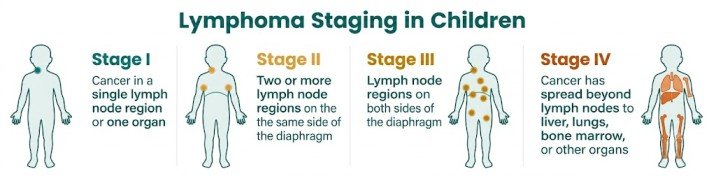
Lymphoma Staging in Children
Lymphoma staging in children determines how far the cancer has spread and directly shapes the treatment plan, ranging from Stage I (localised) to Stage IV (widespread).
Treatment for Childhood Lymphoma
Treatment for childhood lymphoma is typically built around chemotherapy, with radiation therapy, immunotherapy, or stem cell transplant added depending on the subtype, stage, and response to initial treatment.
- Chemotherapy for Pediatric Lymphoma
Chemotherapy is the backbone of treatment for both Hodgkin and Non-Hodgkin lymphoma in children. Combination chemotherapy regimens are used in cycles, with the specific drugs and duration depending on subtype and stage.
- Radiation Therapy for Childhood Lymphoma
Radiation therapy may be used for localised disease or to consolidate treatment after chemotherapy, particularly in Hodgkin lymphoma. It is used selectively in children to minimise long-term effects on growth and development.
- Immunotherapy for Pediatric Lymphoma
Immunotherapy, including monoclonal antibodies that target specific proteins on lymphoma cells, is increasingly used alongside chemotherapy, especially for certain B-cell Non-Hodgkin lymphomas. It offers a more targeted approach with a different side-effect profile than conventional chemotherapy.
- Stem Cell Transplant for Lymphoma in Children
Stem cell transplant, most often autologous (using the child’s own stem cells), is generally reserved for relapsed or high-risk lymphoma that does not respond adequately to first-line treatment. It allows higher-dose chemotherapy to be given safely by restoring the bone marrow’s ability to produce healthy blood cells afterward.
Why Choose Dr. Satyendra Katewa for Pediatric Lymphoma Treatment in Delhi
Dr. Satyendra Katewa is a leading pediatric oncologist in Delhi with over 25 years of experience treating childhood cancers, including Hodgkin and Non-Hodgkin lymphoma, at Max Hospital, Patparganj.
Families searching for the best doctor for lymphoma in children in Delhi can expect:
- Over 25 years of experience in pediatric haemato-oncology and bone marrow transplant.
- A comprehensive approach covering chemotherapy, radiation, immunotherapy, and stem cell transplant under one roof.
- Personalised, evidence-based treatment planning for every child.
- A dedicated team guiding families through diagnosis, treatment, and long-term follow-up.
As one of the most experienced children’s lymphoma specialists in Delhi NCR, Dr. Katewa’s team ensures families receive both advanced clinical care and clear, steady guidance throughout the treatment journey.
What Parents Should Remember:
Lymphoma in children, though serious, is a highly treatable condition with modern medical care.
Parents should not ignore persistent or unusual symptoms, especially enlarged lymph nodes that do not resolve over time. A timely evaluation helps ensure that, if treatment is needed, it can begin at the appropriate stage with the best possible approach.
With structured treatment protocols, multidisciplinary care, and regular follow-up, most children with lymphoma respond well to therapy and can return to normal daily life after treatment.
If you have concerns about your child’s symptoms you can consult Dr. Satyendra Katewa – leading Paediatric Haemato-Oncologist and Bone Marrow Transplant (BMT) specialist in Delhi
Click here to Book Appointment
Frequently Asked Questions
What are the symptoms of lymphoma in children? expand_more
The most common symptom is a painless, persistent swelling in the neck, underarm, or groin lasting more than two to three weeks, often along with fever, night sweats, unexplained weight loss, and fatigue.
How is lymphoma diagnosed in children? expand_more
Diagnosis involves a physical examination, blood tests, imaging such as CT or PET-CT scans, and a lymph node biopsy to confirm the cancer and identify its exact subtype.
What is the treatment for childhood lymphoma? expand_more
Treatment is tailored to the lymphoma subtype and stage, typically combining chemotherapy with radiation therapy, immunotherapy, or stem cell transplant when needed.
What causes lymphoma in children? expand_more
The exact cause is unknown in most cases, but it involves genetic changes in lymphocytes. Risk factors include immune deficiencies, Epstein-Barr virus infection, and, less commonly, family history.
What are the first signs of childhood lymphoma? expand_more
The earliest sign is usually a lymph node swelling that does not resolve on its own, sometimes accompanied by low-grade fever or fatigue that parents may initially mistake for a viral infection.

Dr. Satyendra Katewa's Medical Content Team
Dr. Satyendra Katewa’s medical content team specialises in developing accurate, evidence-based, and patient-focused healthcare content. With strong clinical insight and expertise in medical writing and SEO, the team simplifies complex haematology and oncology information into clear, trustworthy resources that support informed decision-making and reflect Dr. Katewa’s commitment to ethical, compassionate care.
This content is reviewed by Dr. Satyendra Katewa
Related Conditions

Hodgkin Lymphoma Treatment in Delhi: Symptoms, Causes & Expert Care
Hodgkin lymphoma (Hodgkin’s disease) is a type of lymphoma cancer that affects the lymphatic system, the network that protects the…

Leukaemia Treatment in India for Iraq Patients
Many families from Iraq travel to India for leukaemia treatment every year. The reasons are simple: experienced specialists, advanced bone…

Blood Cancer Treatment for International Patients in India
India is one of the most sought-after destinations for blood cancer treatment for international patients, offering chemotherapy, targeted therapy, immunotherapy, and…
Non-Hodgkin Lymphoma Treatment in Delhi
Non-Hodgkin lymphoma (NHL) is a type of lymphoma that affects the lymphatic system, the body’s infection-fighting network. In the NHL,…

Juvenile Myelomonocytic Leukaemia Treatment in Delhi: Symptoms, Causes & Expert Care
A diagnosis of Juvenile Myelomonocytic Leukaemia in your child can feel frightening, especially because it’s so rare that most parents…
Chronic Myeloid Leukaemia Treatment in Delhi
A diagnosis of Chronic Myeloid Leukaemia may feel frightening, but here’s the truth: CML is one of the most treatable…
Related Blogs

Early Signs of Deep Vein Thrombosis in Children
Deep vein thrombosis (DVT) is a blood clot that forms in a deep vein, usually…
Read Article →
Common Pediatric Cancer Myths vs Facts Every Parent Should Know
When a child is diagnosed with cancer, parents are often faced with a flood of…
Read Article →
Blood Cancer in Children: What Should Parents Do First After Diagnosis?
If you’ve just been told that your child has blood cancer, you’re probably feeling shocked,…
Read Article →
When Does a Child Need a Bone Marrow Transplant Instead of Chemotherapy?
Not every child with a blood disorder needs a bone marrow transplant, and not every…
Read Article →
Best Paediatric Haemato-Oncologists in Delhi
When a child is referred to a cancer or blood disorder specialist, it can be…
Read Article →
Early Warning Signs of Childhood Blood Cancer
There are moments in a parent’s life that can feel very difficult; one of them…
Read Article → WhatsApp