
Bone Marrow Transplant for Thalassemia Major in Delhi
For a child with thalassemia major, regular blood transfusions can become a part of everyday life. While transfusions and iron chelation help manage the condition, many parents eventually ask the same important question: Is there a treatment that can reduce or eliminate the need for lifelong transfusions?
For selected children, a bone marrow transplant for thalassemia major can offer a potentially curative treatment option. Also known as a haematopoietic stem cell transplant (HSCT), the procedure replaces the child’s defective blood-forming system with healthy stem cells from a suitable donor.
The decision to proceed with a transplant depends on several factors, including the child’s age, health, iron overload, organ function and availability of a suitable donor. An early evaluation can help families understand whether a transplant is an appropriate option for their child.
Dr. Satyendra Katewa, Paediatric Haemato-Oncologist and Bone Marrow Transplant specialist in Delhi, provides specialised evaluation and transplant care for children with thalassemia and other complex blood disorders.
Reach Out for Expert Care
What Is Thalassemia Major?
Thalassemia major is an inherited blood disorder in which the body cannot produce enough functional haemoglobin. This causes severe anaemia and, in many children, creates a need for regular red blood cell transfusions.
Long-term transfusion therapy can help maintain haemoglobin levels and support normal growth and development. However, repeated transfusions can also cause iron overload, which may gradually affect organs such as the liver, heart and endocrine system.
This is why comprehensive thalassemia treatment in Delhi may involve regular transfusions, iron chelation, monitoring for complications and, in selected children, evaluation for bone marrow transplantation.
Is Bone Marrow Transplant a Cure for Thalassemia Major?
Bone marrow transplant is currently an established, potentially curative treatment for transfusion-dependent thalassemia.
Unlike transfusions and iron chelation, which manage the effects of thalassemia, a successful allogeneic transplant replaces the patient’s blood-forming stem cells with healthy donor stem cells. These cells can then produce healthy blood cells.
A successful transplant may significantly reduce or eliminate the need for regular blood transfusions. However, BMT is a complex procedure and is not suitable for every patient. The potential benefits and risks need to be assessed individually by an experienced transplant team.
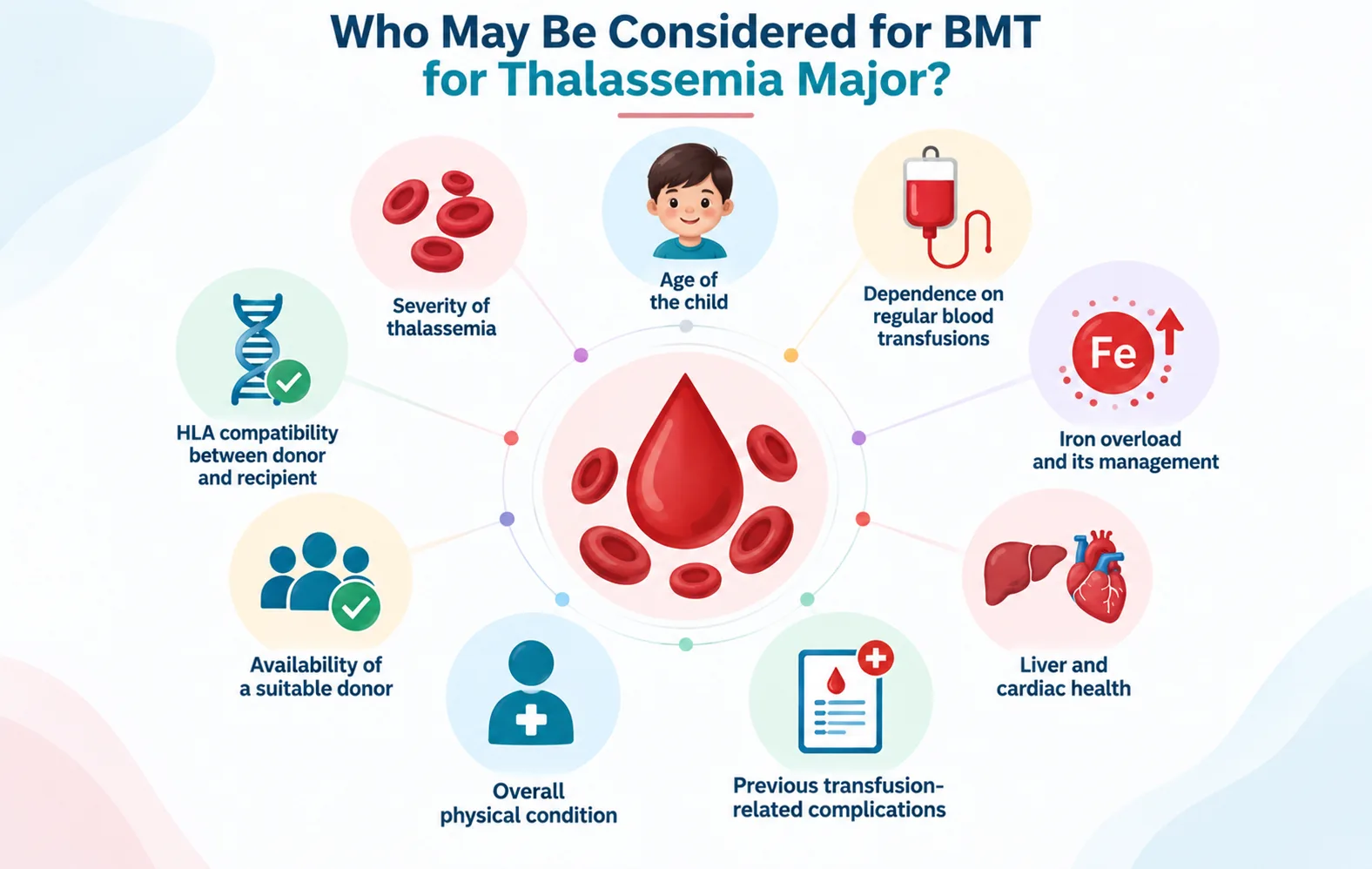
Who May Be Considered for BMT for Thalassemia Major?
Not every child with thalassemia major will automatically need a transplant. A specialist evaluates several factors before recommending the procedure.
These may include:
- Age of the child
- Severity of thalassemia
- Dependence on regular blood transfusions
- Iron overload and its management
- Liver and cardiac health
- Previous transfusion-related complications
- Overall physical condition
- Availability of a suitable donor
- HLA compatibility between donor and recipient
In general, children who are evaluated before significant complications from iron overload develop may have important advantages when considering transplantation.
A detailed consultation is therefore important before making any decision about bone marrow transplant for thalassemia in Delhi.
Finding a Suitable Donor for Thalassemia BMT
Donor selection is one of the most important stages of the transplant process.
Matched Sibling Donor
If the child has an HLA-matched sibling, the sibling may be considered as a donor. A matched sibling donor can be an important option for children with transfusion-dependent thalassemia.
Matched Unrelated Donor
If a matched sibling is unavailable, an appropriately matched unrelated donor may be considered after HLA testing and a detailed assessment.
Haploidentical Donor
A fully matched donor is not available for every child. In such situations, a haploidentical BMT using a partially matched family donor may be considered in selected cases.
Parents are often potential haploidentical donors because they share approximately half of their child’s HLA markers.
Families can learn more about this treatment pathway through the dedicated Haploidentical BMT in Delhi service page.
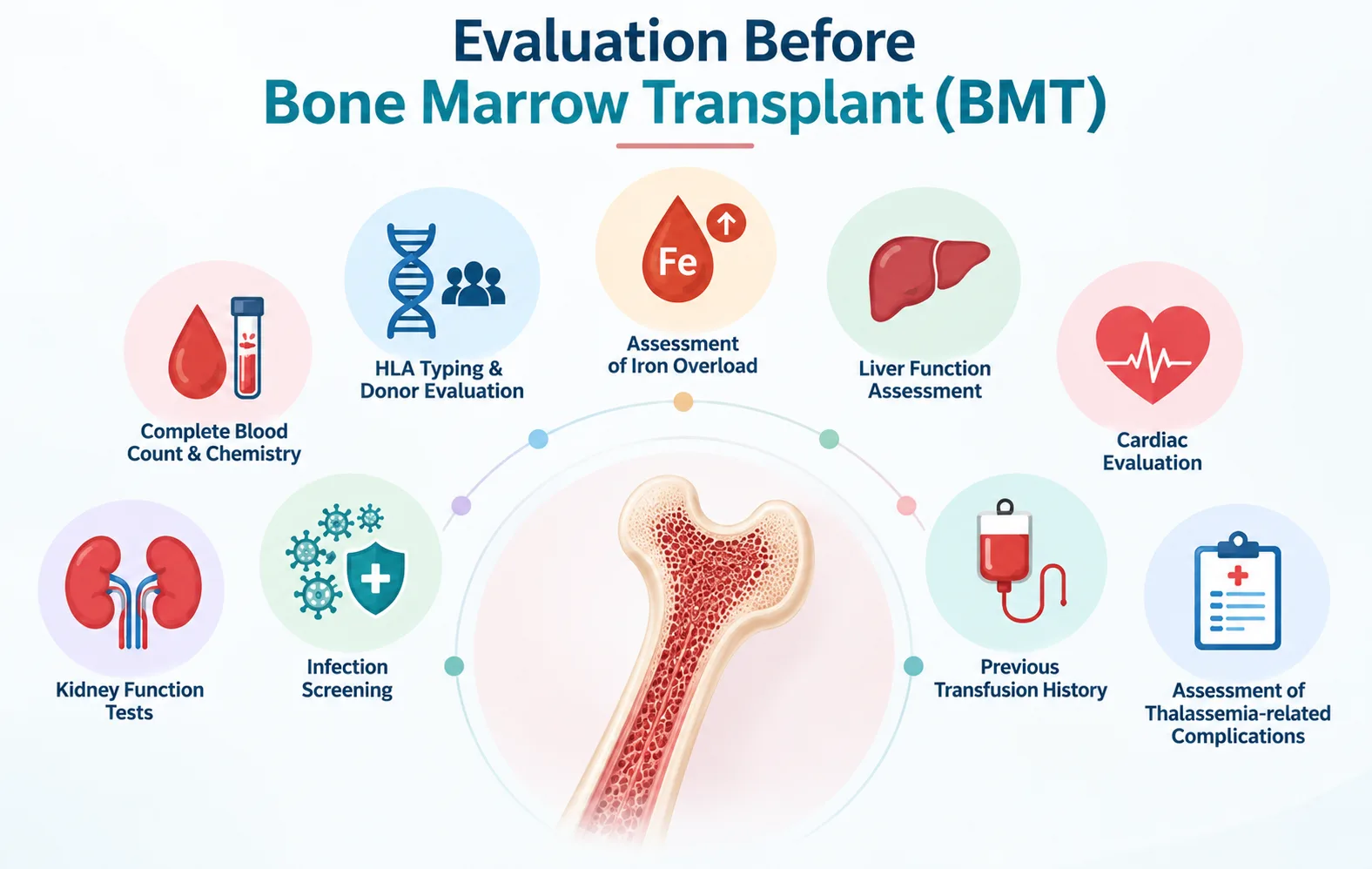
Evaluation Before Bone Marrow Transplant
Before proceeding with BMT, the child undergoes a detailed medical evaluation. The purpose is to understand the child’s current health, identify potential risk factors and determine the most appropriate transplant approach.
The evaluation may include:
- Complete blood count and blood chemistry
- HLA typing and donor evaluation
- Assessment of iron overload
- Liver function assessment
- Cardiac evaluation
- Kidney function tests
- Infection screening
- Previous transfusion history
- Assessment of existing thalassemia-related complications
Iron overload deserves particular attention because children who have received repeated transfusions may have accumulated excess iron over time.
The transplant team may therefore review previous iron studies, chelation therapy and organ function before deciding on the timing and suitability of transplantation.
How Is Bone Marrow Transplant for Thalassemia Performed?
A bone marrow transplant for thalassemia major is performed through several carefully planned stages.
1. Pre-Transplant Assessment
The child’s diagnosis, medical history, organ function and donor compatibility are reviewed. Any correctable health issues are addressed before transplantation.
2. Conditioning Therapy
Before receiving donor stem cells, the child is given a conditioning regimen. This prepares the bone marrow and immune system to receive and accept the donor cells.
The conditioning regimen is selected according to the child’s clinical condition, donor type and transplant protocol.
3. Stem Cell Infusion
Healthy stem cells obtained from the donor are infused into the child’s bloodstream through a central venous line.
The procedure is similar to receiving an intravenous blood product. The transplanted stem cells then travel to the bone marrow.
4. Engraftment
The donor stem cells gradually settle in the bone marrow and begin producing new blood cells.
This period requires close monitoring because blood counts can remain low while engraftment occurs.
5. Post-Transplant Monitoring
After transplantation, the child remains under close medical supervision. The transplant team monitors blood counts, engraftment, infections and other possible complications.
Paediatric Bone Marrow Transplant for Thalassemia
Because thalassemia major is often diagnosed during childhood, paediatric BMT requires specialised transplant care.
Children may have different nutritional, developmental, psychological and infection-control needs compared with adults. The transplant plan therefore needs to take the child’s age and overall development into account.
A paediatric bone marrow transplant in Delhi may involve allogeneic transplantation using a matched sibling, unrelated donor or, when appropriate, a haploidentical family donor.
Early assessment also gives families more time to understand donor options, prepare for transplantation and discuss the expected course of treatment and recovery.
Benefits of Bone Marrow Transplant for Thalassemia Major
For an appropriately selected child, successful BMT may provide important long-term benefits.
These may include:
- Reduction or elimination of regular blood transfusion requirements
- Restoration of healthy blood-cell production
- Reduction in the ongoing burden of transfusion-related iron accumulation
- Reduced dependence on long-term transfusion support
- Potential improvement in long-term quality of life
The outcome, however, varies between patients. Donor type, age, iron overload, organ health and other individual factors can influence the risks and expected results.
Risks and Possible Complications
Bone marrow transplant is a major medical procedure and carries potential risks.
Possible complications include:
- Infections during periods of low immunity
- Graft-versus-host disease (GVHD)
- Graft failure or delayed engraftment
- Effects of conditioning therapy
- Organ-related complications
- Fertility or endocrine complications in some patients
- Other transplant-related complications
The actual risk depends on the child’s condition, donor type, transplant protocol and overall health.
Families should therefore have a detailed discussion with the transplant specialist about both the potential benefits and possible complications before proceeding.
Recovery After Thalassemia Bone Marrow Transplant
Recovery continues well beyond the stem cell infusion.
During the initial period, the child is closely monitored for engraftment, infection and other complications. Once blood counts recover sufficiently and the treating team considers discharge appropriate, follow-up continues on an outpatient basis.
Follow-up may include monitoring of:
- Blood counts
- Donor-cell engraftment
- Infections
- GVHD
- Liver and kidney function
- Nutritional status
- Growth and development
- Long-term transplant-related complications
Immune recovery takes longer than the initial recovery of blood counts, so families need to follow the transplant team’s precautions and follow-up schedule carefully.
What Is the Cost of Bone Marrow Transplant for Thalassemia in Delhi?
The bone marrow transplant cost in Delhi varies from one child to another. It can depend on the type of transplant, donor source, investigations, conditioning treatment, duration of hospitalisation, medicines and management of complications.
The existing thalassemia information on Dr. Katewa’s website provides an indicative BMT range of ₹10 lakh to ₹25 lakh, while noting that actual costs vary according to individual clinical needs.
Families should therefore obtain a personalised estimate after the child’s evaluation rather than relying on a fixed package price.
Why Choose Dr. Satyendra Katewa for Thalassemia BMT in Delhi?
Dr. Satyendra Katewa is a Paediatric Haemato-Oncologist and Bone Marrow Transplant specialist in Delhi with more than 25 years of experience in managing childhood blood disorders and paediatric cancers.
His areas of expertise include thalassemia, leukaemia, aplastic anaemia, sickle cell disease, immune disorders and different types of bone marrow transplantation.
His approach involves detailed evaluation of the child’s condition, donor availability, transplant suitability and long-term follow-up.
You can learn more about Dr. Satyendra Katewa’s qualifications, experience and areas of expertise on his profile page.
When Should Parents Consult a BMT Specialist?
If your child has thalassemia major and requires regular blood transfusions, a discussion with a transplant specialist can help you understand whether BMT may be an option.
An early consultation can help answer important questions about:
- Whether your child may be eligible for transplant
- Available donor options
- HLA matching
- Iron overload and organ health
- Potential benefits and risks
- Expected hospital stay and recovery
- Estimated treatment costs
The decision should always be personalised to the child’s medical condition rather than based solely on age or transfusion dependence.
Consult Dr. Satyendra Katewa for Thalassemia BMT in Delhi
A diagnosis of thalassemia major can feel overwhelming, particularly when your child requires repeated transfusions. Understanding all available treatment options can help your family make informed decisions about the next step.
If you are considering bone marrow transplant for thalassemia major in Delhi, consult Dr. Satyendra Katewa for a detailed evaluation of your child’s condition, donor options and transplant suitability.
Book a consultation to discuss whether bone marrow transplantation may be an appropriate treatment option for your child.

Dr. Satyendra Katewa's Medical Content Team
Dr. Satyendra Katewa’s medical content team specialises in developing accurate, evidence-based, and patient-focused healthcare content. With strong clinical insight and expertise in medical writing and SEO, the team simplifies complex haematology and oncology information into clear, trustworthy resources that support informed decision-making and reflect Dr. Katewa’s commitment to ethical, compassionate care.
This content is reviewed by Dr. Satyendra Katewa
Related Treatments

Bone Marrow Transplant in Patparganj
A child’s diagnosis requiring a bone marrow transplant can be emotionally and physically overwhelming for the entire family. Timely access…
Stem Cell Transplant in Delhi
Stem cell transplant is a specialised procedure that replaces diseased or damaged bone marrow with healthy blood-forming stem cells. These…
Bone Marrow Transplant in Delhi
Diseased bone marrow is replaced with healthy stem cells to restore normal blood formation in conditions like AML, ALL, JMML,…
Bone Marrow Transplant (BMT) in Delhi for International Patients
Explore bone marrow transplant options in Delhi for international patients, including a clear treatment process, donor matching, cost considerations, and…
Paediatric Bone Marrow Transplant in Delhi
A paediatric bone marrow transplant in Delhi is an advanced procedure for managing several complex blood and immune system disorders…
Autologous Bone Marrow Transplant in Delhi
Autologous Bone Marrow Transplant (ABMT), also known as Autologous Stem Cell Transplant (ASCT), is a procedure in which a patient’s own…
Related Blogs
Low Platelet Count: Causes, Symptoms & What Level Is Dangerous
A low platelet count, medically called thrombocytopenia, means fewer than 150,000 platelets per microlitre (µL)…
Read Article →
Normal Platelet Count in Children: Range, Low Levels and When to Worry
A blood test can raise questions when your child’s platelet count falls outside the normal…
Read Article →
What Are Stem Cells in Bone Marrow Transplant?
Stem cells are at the heart of a bone marrow transplant (BMT). They are special…
Read Article →
How to Get Financial Help for a Child’s Cancer Treatment in India
When a child is diagnosed with cancer, parents have to think about much more than…
Read Article →
Sickle Cell Disease vs Thalassaemia: Differences & Treatment Options in Delhi NCR
Sickle cell disease and thalassaemia are both inherited blood disorders that affect haemoglobin, the protein in…
Read Article →
Life After Pediatric Bone Marrow Transplant: A Parent’s Complete Guide
Quick Summary Recovery takes months – The first 100 days at home are the most…
Read Article → WhatsApp